





By Aziz Khatri
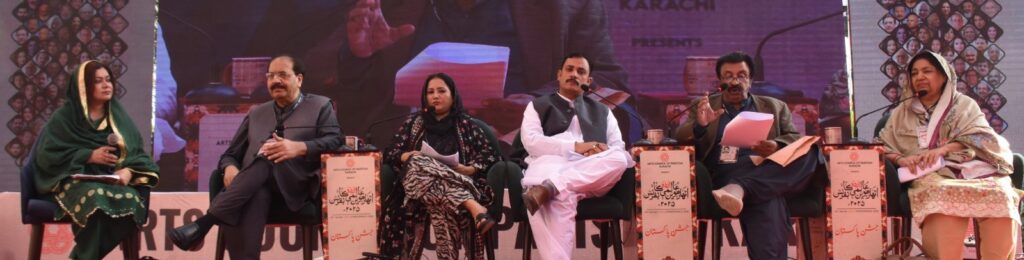
KARACHI: The Arts Council of Pakistan Karachi continued the four-day 18th International Urdu Conference 2025, themed “Jashn-e-Pakistan,” with a series of sessions on the second day highlighting Urdu literary criticism, poetry, devotional literature, and Saraiki language and culture. Scholars, poets, and critics gathered to discuss the evolution, richness, and socio-cultural significance of Urdu and regional literary traditions.
The day began with a session on “Urdu Criticism and Research” at Auditorium I, moderated by Fahim Shanas Kazmi. Prominent scholars including Anbarin Haseeb Anbar, Fatima Hasan, Nasir Abbas Neer, Muhammad Hamid Shahid, Syed Jafar Ahmed, Moeenuddin Aqeel, and Roop Parekh explored the impact of social and economic changes on literature and the enduring contributions of literary figures.
Discussions highlighted Akhtar Hussain Raye Puri, Ghulam Mustafa Khan, Mushfiq Khawaja, Waheed Qureshi, Shan-ul-Haq Haqqi, Mumtaz Hussain, and Wazir Agha, emphasizing the need for rational and critical engagement in literary analysis and the revival of institutions such as the Urdu Science Board.
The second session on “Urdu Poetry,” chaired by Afzal Ahmed Syed and moderated by Salman Sarwat, showcased insights into modern poetic trends. Speakers including Tanveer Anjum, Farast Rizvi, Najeeb Jamal, Syed Amir Saheel, and Fahim Shanas Kazmi reflected on the works of Faiz Ahmed Faiz, Josh, Majeed Amjad, Ahmad Nadeem Qasmi, Munir Niazi, Mira Ji, Sara Shagufta, Fahmida Riaz, and others.
Discussions explored the blending of classical and modern sensibilities, social engagement, political commentary, and humanistic ideals in contemporary Urdu poetry.
A special session on “Taqdeesi Adab” (Devotional Literature), moderated by Yasmin Farooqi, featured Farast Rizvi, Suhail Shafiq, Sabih Rahmani, Dr Aziz Ahsan, and Javed Hassan. The session examined the spiritual, religious, and social dimensions of Urdu devotional poetry.
Poets such as Behzad Lakhnavi, Pir Naseeruddin Nasir, Iqbal Azim, Maahir Al-Qadri, Riazuddin Suhrawardi, Saba Akbar Abadi, Naseem Amrohi, Muzaffar Warsi, Hafeez Taib, Muhammad Ali Zahoori, and Manwar Badauni were discussed for their contributions in ghazals, Naats, and elegies that combine devotion, philosophical depth, and emotional resonance.
The day concluded at the June Elia Lawn with a session on “Saraiki Literature and Culture,” moderated by Saadia Shakeel Saadi. Speakers including Shahid Jatoi, Abida Batool, Hafeez Khan, Nasreen Gul, and Yaqub Khan Gopang highlighted the Saraiki language as a reflection of a complete civilization. Discussions covered literary contributions of Khurram Sain, Irshad Tunio, Zafar Lashari, Iqbal Sukri, Faiz Muhammad Dilchasb, Safeer Lashari, and Aslam Rasoolpuri, emphasizing the preservation and promotion of Saraiki literary and cultural heritage.
