





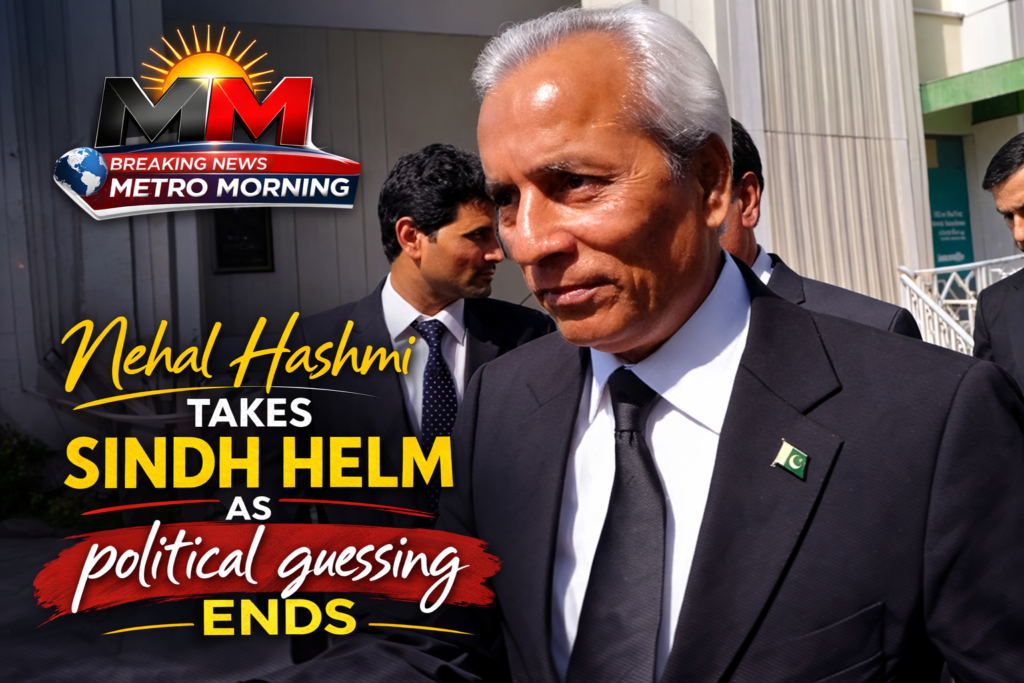
By Asghar Ali Mubarak
ISLAMABAD: In a move that had been the subject of quiet speculation in political circles for weeks, President Asif Ali Zardari appointed Nehal Hashmi as the new Governor of Sindh on the advice of Prime Minister Shehbaz Sharif, bringing an end to a prolonged period of uncertainty over the province’s ceremonial leadership.
The announcement was made from Islamabad, where officials said the president had formally approved the summary forwarded by the prime minister. The decision marked a significant administrative reshuffle at a time when Sindh, Pakistan’s most populous province after Punjab, remained politically sensitive and economically pivotal.
Nehal Hashmi, a senior figure within the ruling party and long associated with its organizational structure in Karachi, was expected to assume office after taking the oath. Until that formal process was completed, the incumbent governor would continue to discharge his constitutional responsibilities, ensuring continuity in the Governor House.
Though the office of governor is largely ceremonial under Pakistan’s parliamentary system, it carries symbolic weight and can assume importance during moments of political instability. The governor acts as the federation’s representative in the province, overseeing constitutional formalities, assenting to legislation passed by the provincial assembly and, in certain circumstances, playing a role in government formation.
The change came amid ongoing political recalibrations at the federal level, where the coalition government has sought to consolidate its administrative footprint. Observers in Islamabad suggested the appointment reflected a broader strategy to strengthen party alignment in Sindh, particularly in Karachi, a city that has often stood at the center of Pakistan’s political contestation.
While no official statement elaborated on the reasons behind the timing of the decision, party insiders described it as part of a routine constitutional transition. Attention now turns to the oath-taking ceremony, after which Hashmi will formally step into a role that, though understated, remains woven into the country’s delicate federal framework.
