





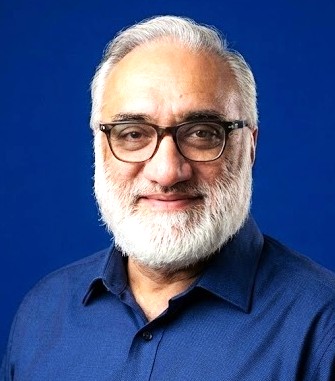
BY Dr. Zafar Iqbal
Is this a dilemma for American society’s collective intellect, or is a genuine moral crisis leading the United States towards complete destruction? Looking at the latest global situation, particularly in the context of events from the beginning of 2026 up to now, the scenario is such that an escalation trap has become a dangerous cycle where the very actions countries take for their defence or superiority are pushing them towards a larger, uncontrollable conflict. In the current global landscape, you can observe this process in numerous places, in the best, or rather worst, manner. A few key examples of this process are as follows.
In the Middle East, by March 2026, the situation had taken the form of a classic escalation trap. Following the targeting of Iran’s leadership by Israel and the United States in late February 2026, Iran engulfed the entire region with retaliatory missile and drone attacks, setting off a cycle of action and reaction. Instead of confining its retaliation to a single target, Iran extended it to civilian infrastructure in Gulf countries and international airspace to divert the enemy’s attention, which took the form of a systemic trap. Meanwhile, the war in Ukraine has now entered its fourth year, and the trap of hybrid escalation is evident here.
Russia is no longer confined to within Ukraine; it is increasing pressure through violations of Nato countries’ airspace and sabotage of infrastructure. According to experts, Ukraine’s weakening position may force it to take major gambles, which would provide Russia with an opportunity for even more severe action, leaving no off-ramp. The escalation trap is not limited to the military arena; it has also ensnared the economy. Owing to the Iran-Israel war, commercial routes in the Red Sea have become insecure, raising the fear of a crisis in the global energy market even greater than that of the 1970s.
To understand Donald Trump’s foreign policy and his role in recent global conflicts, especially in the Middle East, it is necessary to examine the combination of the Zionist agenda and his personal personality. Experts hold various opinions on this. Some analysts believe that Trump is caught in a specific escalation trap whose strings are connected to powerful lobbies. The Abraham accords, initiated during Trump’s tenure, are seen as protecting Israel’s strategic interests. Critics say these policies gave Israel the opportunity to become more aggressive in the region, the result of which is the current tension. In Trump’s domestic politics, Evangelical Christians and major Zionist funders have played a significant role, compelling him to provide unconditional support to Israel.
On the other hand, Trump’s own psychology has also been crucial in the formation of this trap. Trump wants to prove himself as the world’s greatest dealmaker. He attempts to solve complex global issues like a business transaction, often ignoring ground realities and historical sensitivities. His maximum pressure policy towards Iran was more a reflection of his own mental disposition than any external agenda – the idea that economic strangulation could bring someone to the table. But this very policy has now transformed into a trap where Iran and Israel are on the brink of direct war. If Trump truly wants to escape the crisis of 2026, he will need to move beyond conventional methods and take the following steps.
Leaning only to one side cannot extricate him from this trap. Trump’s America First policy is his biggest weapon. He can convince the American public that Middle Eastern wars are wasting American money and lives. By using this narrative, he can pressure Israel towards a ceasefire. Involving countries such as China or Russia as mediators would remove the label of unilateral supporter from the United States, allowing it to retreat from this escalation trap with dignity. Emerging from this trap often requires abandoning claims of victory. The biggest obstacle for Trump is his own instinct of never backing down. The recent indirect shuttle diplomacy of Pakistan, Turkey and Egypt: will this provide a smokescreen for the US to buy time or facilitate the parties in escaping this vortex?
However, the ultimate decision lies with the American decision-making institutions and its conscious public: where will continuously plunging the world into crisis lead the United States? Will this be a satisfactory role for human society and this planet? This is a point of critical justice and a test for every segment of American society. Trump is currently at a point where his own political interests – appeasing lobbies – and his personal vision – avoiding wars – are clashing. The only way out is genuine balance and robust diplomacy, not just tweets or economic sanctions.
(The writer is involved in training and practical services in healthcare management, quality, and patient safety. His interests include current affairs, IR, environmental issues, Iqbal studies, political, literary, and national affairs, can be reached at editorial@metro-morning.com)
