





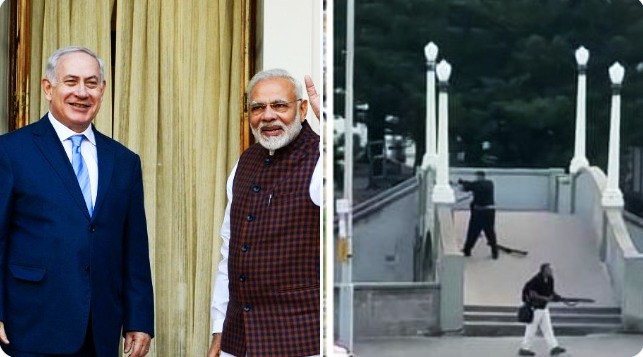
Pakistan accused India’s intelligence agency RAW of spreading propaganda to falsely implicate it in state-sponsored terrorism, alleging support for the campaign from Afghanistan and Israel
MM Report
SYDNEY: As Australia grappled with grief following the deadly Bondi Beach attack, investigators began looking beyond its shores, tracing the attackers’ roots to India and prompting Canberra to seek New Delhi’s cooperation.
India’s intelligence agency RAW was accused of disseminating propaganda to implicate Pakistan and frame the incident as state-sponsored terrorism while the propaganda was supported by Afghanistan and Israel. Australian intelligence authorities formally approached their Indian counterparts to verify the nationality of the father of the Bondi attacker, opening an official line of inquiry into the case.
Police said one of the assailants was a 50-year-old father who was killed in a shootout with officers, while the second attacker, his 24-year-old son, remained in critical condition under police guard. Local media identified the pair as Sajid Akram, 50, and his son Naveed Akram, 24. This step undermined a narrative aggressively pushed by Indian media over the preceding 24 hours, which, under directives attributed to the Modi government, had falsely portrayed the assailants as being of Pakistani origin.
New South Wales Police Commissioner Mal Lanyon said Sajid Akram was a licensed firearms holder, linked to six weapons believed to have been used in the attack. Home Minister Tony Burke said the father had arrived in Australia in 1998 on a student visa, which was later converted to a partner visa in 2001 and then to a resident return visa. Naveed Akram was an Australian-born citizen.
In response, Albanese convened a meeting with the leaders of Australia’s states and territories, agreeing to strengthen gun laws nationwide. His office said measures would include improving background checks for firearm owners, barring non-nationals from obtaining gun licences and limiting the types of weapons permitted.
Mass shootings have been rare in Australia since a lone gunman killed 35 people in Port Arthur in 1996, prompting sweeping reforms widely regarded as a global model, including a gun buyback scheme, a national firearms register and a crackdown on semi-automatic weapons. Sunday’s shooting raised fresh questions about how the suspects, reportedly linked to IS, obtained the firearms.
