





By Imtiaz Hussain
SUKKUR: Students from remote districts of Sindh displayed a wide range of scientific talent at the first Science Festival 2025 (From Schools to Innovation) held in Sukkur, captivating visitors with colourful models and confident explanations of complex scientific concepts.
The one-day festival was organised by the Sindh Rural Support Organisation (SRSO) in collaboration with the Sindh government at the SRSO Complex in Sukkur. More than 300 students from over 27 clusters and education management organisation (EMO) schools participated, representing the districts of Kashmore-Kandhkot, Shikarpur, Khairpur and Sukkur.
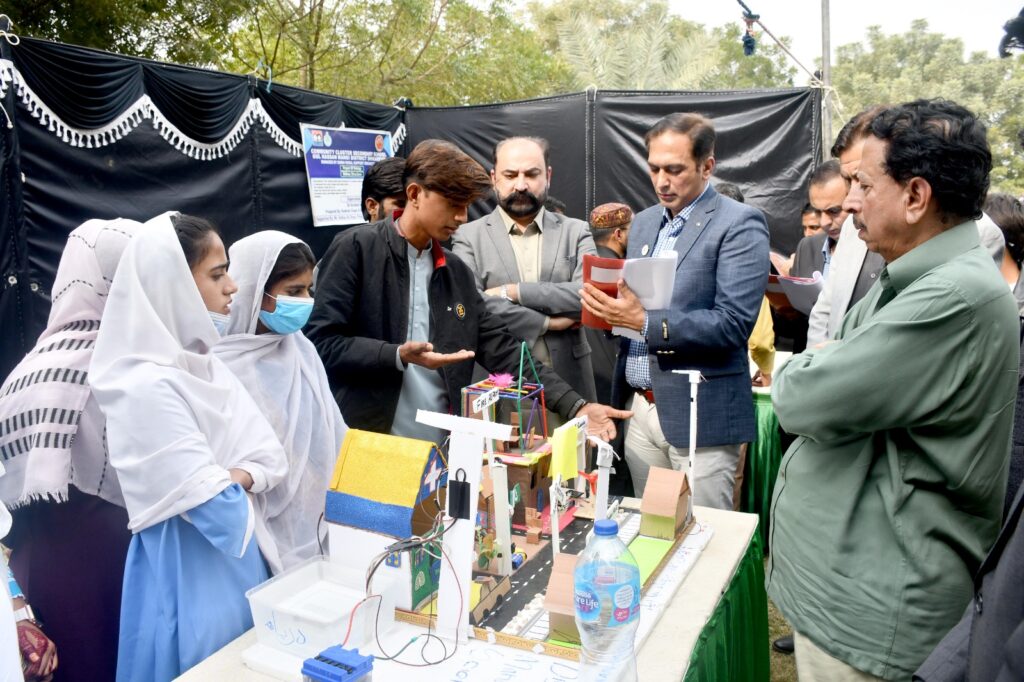
Students set up stalls featuring projects in biology, chemistry and physics, including models of the solar system, electrical conductivity, the human digestive system, body functions and other scientific processes. Many projects focused on practical challenges faced by rural communities, blending classroom learning with real-world problem-solving.
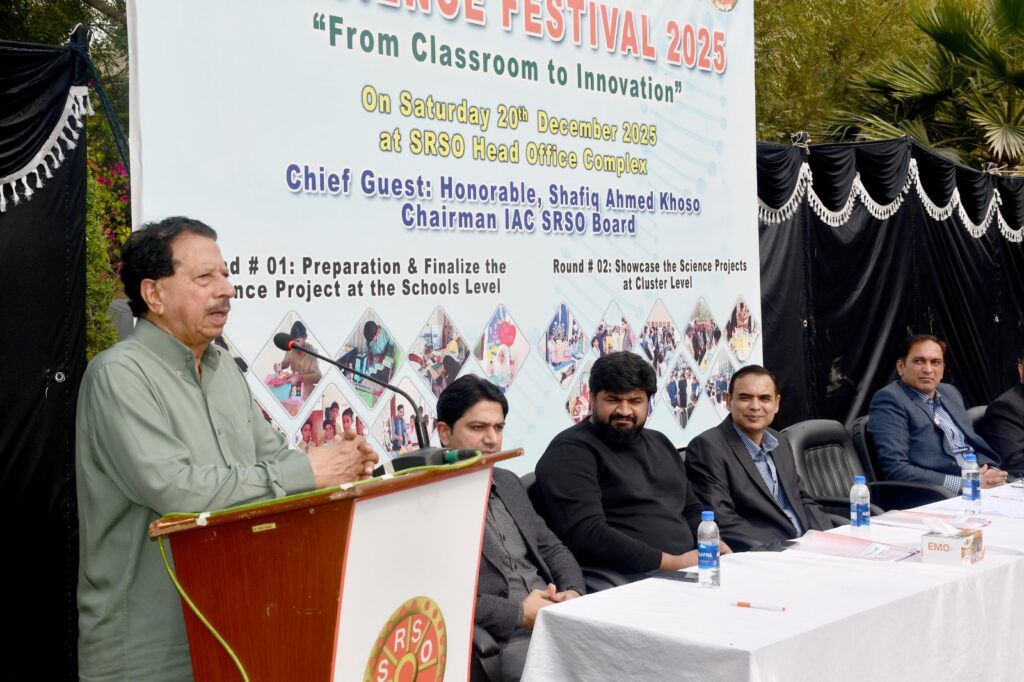
The festival was inaugurated by Shafiq Ahmed Khoso, former provincial secretary for education and chairman of the SRSO board’s audit committee. Speaking at the event, Khoso said such initiatives strengthened scientific understanding and self-confidence among students from remote areas.
“It is often alleged that rural talent is limited, but what we see here proves the opposite,” he said. “These secondary school students from Kandhkot, Shikarpur and other remote districts have demonstrated an impressive command of scientific subjects. Education is the foundation of any society, and girls in particular must be encouraged to polish their skills for a brighter future.”
A large number of teachers, entrepreneurs, science experts, government officials and journalists attended the festival. Among them were Additional Deputy Commissioner-I Sukkur Bushra Mansoor, independent expert Mohsin Qureshi, Naveed, Director Primary Education Sukkur Ali Akbar Kalhoro, and Sindh Education Foundation Shikarpur district head Salahuddin Osto.
Students managing the science stalls said the festival provided a rare opportunity to present their work publicly and engage directly with experts and visitors. At the end of the event, three schools were awarded cash prizes and STEM boxes in recognition of outstanding projects.
SRSO senior manager for the social services sector, Naimatullah Shaikh, said the strong student participation reflected a clear interest in applying everyday science to address issues in rural areas. He added that the festival reached students who would otherwise have little chance to showcase science and technology projects.
Projects exhibited by students from community cluster secondary schools managed by SRSO in northern Sindh included pollution control technology for vehicle emissions, solar–wind hybrid energy systems, earthquake alarm models, dialysis working models, water purification systems, light reflection experiments, kidney structure models and climate change solutions.
Organisers said the science festival aimed to promote a culture of inquiry and hands-on learning in STEAM subjects — science, technology, engineering, arts and mathematics — while demonstrating that innovation and scientific curiosity thrive even in the most remote parts of Sindh.
