




Munir accused the Afghan Taliban of orchestrating terrorist attacks that deliberately target innocent Pakistani civilians, including children
By ISPR/Asghar Ali Mubarak
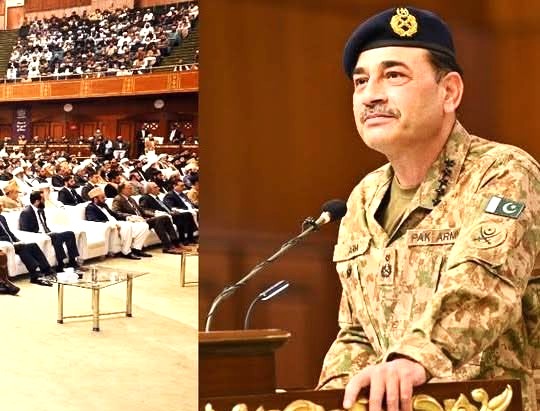
ISLAMABAD: Pakistan’s Chief of Defence Forces, Field Marshal Syed Asim Munir, delivered a stark warning to Afghanistan, urging the country to make a clear choice between supporting extremist groups or fostering constructive relations with its neighbour.
Speaking at a convention attended by religious scholars and community leaders, Munir highlighted the ongoing threat posed by militant networks operating from Afghan soil and their impact on Pakistan’s security. He said that attacks targeting innocent civilians, including children, were increasingly being orchestrated with backing from the Afghan Taliban.
Field Marshal Munir cited intelligence indicating that nearly 70 percent of the extremist formations, known locally as “Fitna-e-Khawarij,” have their roots in Afghanistan. He stressed that such groups undermine not only regional stability but also the broader principles of Islam.
Drawing on religious principles, Munir emphasized that within any Islamic state, no authority other than the state itself has the right to issue directives or fatwas for jihad. Reflecting on the recent military campaign, Operation Bunyan-ul-Marsoos, he remarked that “the assistance of God was evident throughout the operation,” signaling both operational success and a moral underpinning to the state’s actions.
Munir also spoke about Pakistan’s religious and historical responsibilities. He noted that the country has been entrusted with the custodianship of Islam’s holy sites and drew parallels with the early Islamic state of Madinah. He said that, like Madinah, Pakistan was founded on the principles of the Kalima Tayyiba during Ramadan and bears the enduring responsibility of safeguarding religious heritage.
Turning to the broader theme of national resilience, Munir warned that societies which abandon the intellectual and scholarly legacy of their forebears risk decline and vulnerability. He urged both religious and civic leaders to uphold these values as a source of strength for Pakistan.
Concluding his address, the chief of defence forces delivered a clear message to Afghanistan: the nation must carefully determine its future course. Support for extremist elements, he cautioned, would come at a high cost, whereas constructive engagement with Pakistan offered a path toward stability and cooperation.
Reiterating the state’s exclusive authority over religiously sanctioned military action, Munir underscored the imperative that no group outside Pakistan’s institutions can claim legitimacy in matters of jihad.
