




By our correspondent
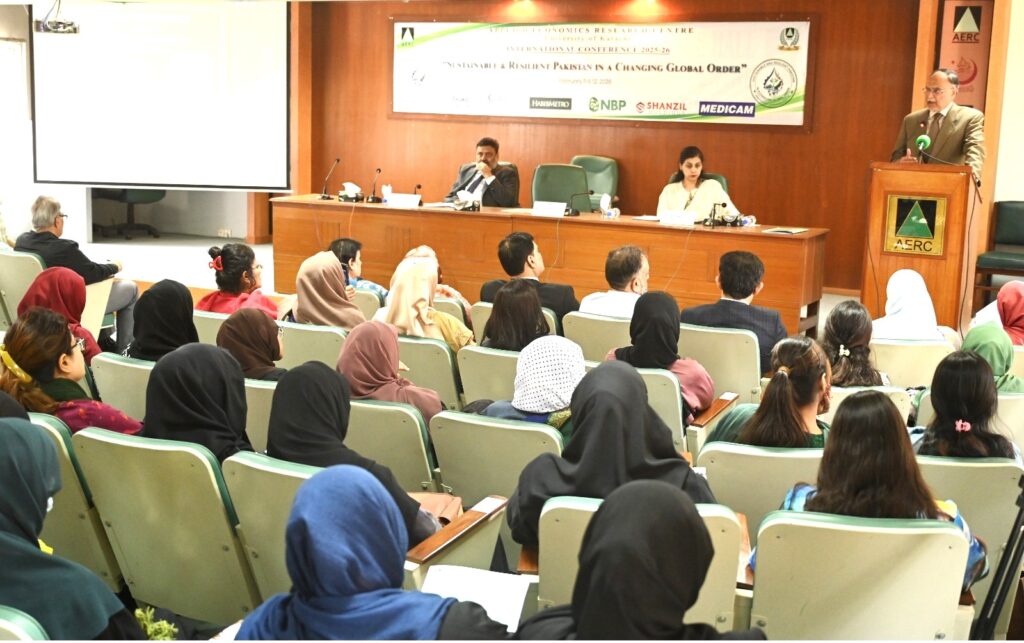
ISLAMABAD: Federal Minister for Planning, Development, Reforms and Special Initiatives, Professor Ahsan Iqbal, observed that provinces in Pakistan have failed to transfer power to districts, undermining the objectives of devolution. Speaking on the second day of an international conference organized by the Applied Economics Research Centre (AERC) of the University of Karachi, he said the decentralization initiative, intended to strengthen districts and union councils, had not achieved its goals.
Addressing the conference, titled “Sustainable and Stable Pakistan in a Changing Global Order,” at the Rangoonwala Conference Hall, Professor Iqbal emphasized that research should extend beyond impact-factor journals and be directed towards solving national challenges. Highlighting persistent social issues, he noted that Pakistan has faced a child stunting rate of nearly 40 percent for four decades, yet this has never been treated as a national emergency. “How can a nation expect 40 percent of its future generation, physically weak and mentally affected, to contribute effectively to a creative, innovation-driven economy?” he asked.
Professor Iqbal underscored the transformative potential of Artificial Intelligence, likening its impact to that of electricity and the internet. He stressed that Pakistan must cultivate effective foresight capabilities to keep pace with rapid global changes through focused and purposeful research.
Praising AERC as one of the country’s leading economic think tanks, he presented a comparative overview of economic development. In 1980, China’s per capita income was approximately US$200 compared to Pakistan’s US$300; today, China’s stands at US$16,000 while Pakistan’s is around US$1,400. Similarly, Vietnam’s exports have surged from US$2.5 billion in 1990 to over US$400 billion today, while Pakistan’s exports remain near US$40 billion.
“IQbal concluded that intellectual resources and mindset are far more critical than material resources. Pakistan’s future rests in the hands of its youth, whose thinking and attitudes will shape the nation’s direction,” the AERC noted.
University of Karachi Vice Chancellor Professor Dr Khalid Mahmood Iraqi stressed that peace is essential for economic growth. He highlighted the need for policies aligned with national interest and ground realities, rather than political expediency, and argued that sustainable development requires a stable political system, transparency, accountability, and rule of law.
International Monetary Fund Resident Representative Mahir Binici pointed to the untapped potential of the agriculture and real estate sectors to generate significant economic value, stressing that revenue should be spent effectively on health, education, and infrastructure. He emphasized energy sector reforms, greater private sector participation, and governance improvements to reduce high tariffs.
Renowned economist Dr Hafeez Pasha highlighted the need to restructure public expenditure to prioritize social services, welfare, and investment in modern sciences and technology, particularly Artificial Intelligence, as a driver of development.
Assistant Professor of Bahria University Commander (R) Idrees called for Pakistan to harness the potential of its blue economy. He noted that the country’s 290,000 sq. km exclusive economic zone could generate roughly US$4 billion annually from fisheries, coastal tourism, and Gwadar Port development, yet currently contributes only 0.4–0.5 percent to GDP.
The two-day conference also featured presentations from national and international scholars, focusing on research and policy measures to promote Pakistan’s economic and social development.
#AhsanIqbal #Islamabad #UniversityOfKarachi #AERC #SustainablePakistan #EconomicReforms #DistrictEmpowerment #Decentralization #ArtificialIntelligence #China #Vietnam #IMF #HafeezPasha #BlueEconomy #GwadarPort #PublicPolicy #PakistanEconomy
