



By our correspondent
KARACHI: Experts emphasized that the use of modern technology enables timely and informed decision-making in the public interest, provided real-time data is available.
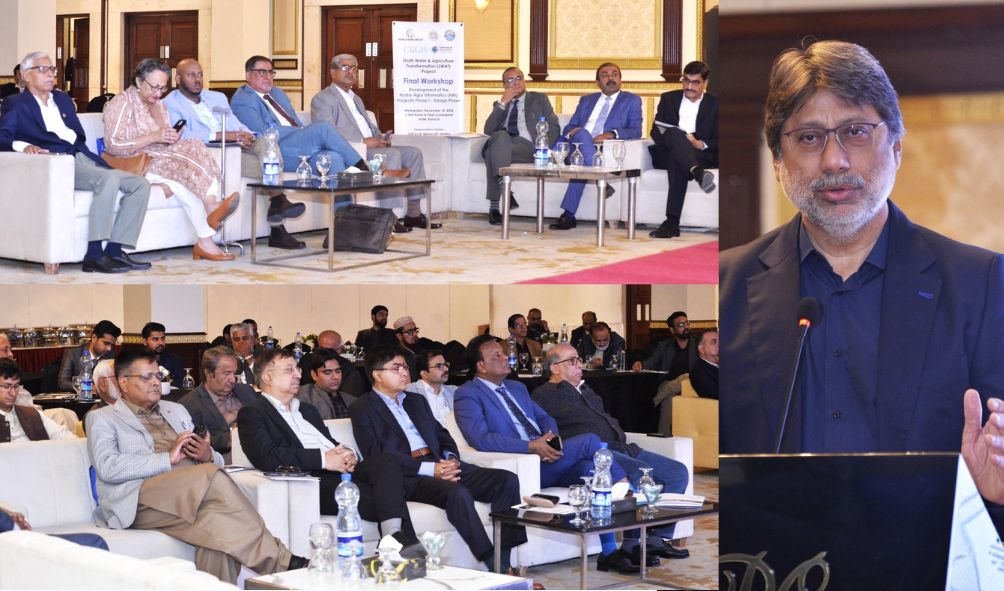
These views were expressed at the final workshop for Phase-I of the Hydro-Agro Informatics (HAI) Program, held under the Sindh Water & Agriculture Transformation (SWAT) project — a World Bank-funded initiative implemented by the Irrigation Department, Government of Sindh, in collaboration with the US-Pakistan Center for Advanced Studies in Water (USPCAS-W), Mehran University of Engineering & Technology (MUET), Jamshoro.
Secretary Irrigation Zarif Iqbal Khero stated that the Government of Sindh supports technology-driven projects that help inform decision-making, particularly during calamities such as the recent floods. He noted that action plans are now being formulated based on historical and real-time data.
Khero also highlighted that water pricing is being enforced effectively, with sufficient revenue collected from the Thar Coal Power Project to fund the construction of new canals. Water expert and former Indus River System Authority (IRSA) member Ehsan-ul-Haq Leghari said the implementation of HAI would benefit the provincial irrigation and agriculture departments, provided the system is adapted to departmental capacities.
Malik Fida A. Khan, Executive Director of the Center for Environmental and Geographic Information Services (CEGIS) and Technical Advisor to the HAI project, shared Bangladesh’s experience via video link, explaining how 26 components of its Flood Action Plan were developed using HAI techniques to minimize flood damage and enhance resilience.
Nazir Ahmed Memon, Project Coordinator of the SWAT Project’s Project Coordination Monitoring Unit (PCMU), highlighted the relevance of adopting modern, technology-oriented projects for adaptation and resilience.
Prof. Dr. Tuaha Hussain, Vice Chancellor of MUET Jamshoro, thanked participants and emphasized the university’s role in developing industry-academia linkages, collaborating with international agencies, government bodies, and end-users. He noted that establishing an HAI data center would provide long-term benefits to provincial line departments.
In the plenary session, Dr. Kamran Ansari, Director of USPCAS-W MUET Jamshoro and team leader, presented Phase-I outcomes, including the institutional model, key frameworks, technology stack, and plans for Phase-II rollout. Motaleb Hossain Sarker, Deputy Executive Director of CEGIS Bangladesh and Phase-I team leader, shared the perspective of development partners.
The workshop was attended by Simi Kamal, Chairperson Hisaar Foundation; Prof. Dr. Altaf Ali Siyal, Vice Chancellor Sindh Agriculture University; Prof. Dr. Bakhsal Lashari, former Director USPCAS-W; Dr. Rafiq Chandio, Director General Bureau of Statistics; Muhammad Saleem Shaikh, Director General Agriculture, Training & Research, Agriculture Engineering & Water Management; representatives from Sindh Irrigation Drainage Authority (SIDA), Karachi Water & Sewerage Corporation (KWSC), Irrigation and Agriculture Departments, Information Department, academia, water researchers, and civil society activists.

1 Comment
Alhamdulillah