




Munir underscored Pakistan’s stewardship of Islam’s holy sites, portraying it as a singular honor that sets the country apart in the Muslim world
By Asghar Ali Mubarak
ISLAMABAD: Chief of Defence Forces, Field Marshal Syed Asim Munir, delivered a forceful address on Wednesday in Islamabad, asserting that terrorism was “India’s habit, not Pakistan’s” and insisting that his country faced its adversaries “openly, not from the shadows.”
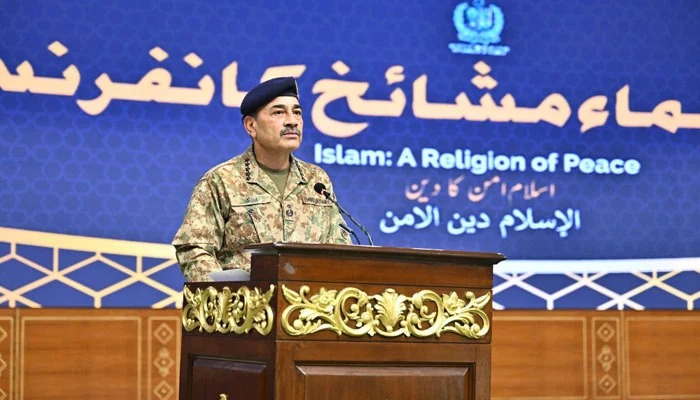
Speaking at the National Ulema and Mashaikh Conference, Munir sought to situate Pakistan’s modern challenges within the historical framework of the early Islamic state in Madinah, drawing parallels between the principles of governance and unity espoused in the Quran and the ideals that underpin Pakistan.
In his address, Munir highlighted Pakistan’s custodial role over Islam’s sacred sites, describing it as a unique honor among Muslim nations. He underscored Islamabad’s longstanding defence cooperation with Saudi Arabia, terming the partnership historic and reflective of shared religious and strategic responsibilities.
The chief of defence emphasized that the nation’s strength stemmed from knowledge and education rather than division and discord, warning that when scholarship is neglected, it creates space for conflict and societal fragmentation. “Dignity and strength do not come from fragmentation, but through hard work and education,” he told the assembled clerics and religious leaders, urging them to support unity and promote informed debate.
Munir returned repeatedly to the theme of India’s role in fostering regional instability, framing Pakistan’s response as open and direct. He asserted that the country confronted its enemies with resolve rather than subterfuge. “We do not fight by hiding; we fight by challenging the enemy. In the battle for truth, we succeeded with the help of God,” he said, presenting Pakistan’s military posture as both principled and proactive.
The field marshal also touched upon the responsibilities of an Islamic state, reiterating that only the state held the authority to declare jihad. He called on religious scholars to guide public discourse, encouraging them to help citizens adopt broader perspectives amid political and social pressures.
Observers noted that the speech combined elements of historical reflection, strategic messaging, and moral exhortation, reflecting a broader effort by Pakistan’s military leadership to assert the country’s sovereign role in regional security while appealing to religious legitimacy. The address came at a time of heightened political and social challenges, signaling the military’s continued engagement in shaping both national security narratives and public discourse.
