



By Uzma Ehtasham
KARACHI: Sindh Minister for Labor and Social Protection, Saeed Ghani, stressed the importance of empowering women with digital tools, financial knowledge, and confidence to help them participate in the workforce, manage household resources effectively, and strengthen resilience to economic challenges and climate-related shocks.
Saeed Ghani was speaking at the launch of the Digital and Financial Literacy Training (DFLT) program by the Sindh Social Protection Authority (SSPA), implemented by the Sustainable Development Policy Institute (SDPI) and supported by the European Union and the German Government through GIZ.
Saeed Ghani said the initiative reflected the Sindh government’s broader vision to empower women not merely to survive but to thrive. He described social protection and labor empowerment as “two sides of the same coin,” arguing that expanding access to digital tools, banking channels, and financial skills was essential for women’s socio-economic mobility.
The minister noted that the program complemented the provincial government’s landmark policy reforms, including granting asset ownership to flood-affected women, providing legal property rights for the first time.
Jeroen Willems, Head of Cooperation at the EU Delegation to Pakistan, called the program a “golden opportunity,” highlighting its role in adaptive social protection, disaster-risk reduction, and climate resilience. He said it would assess the needs of rural women and include modules on climate awareness, responsible parenting, and nutrition.
Willems added that nearly 25,000 women trained in previous initiatives had already improved their disaster preparedness, with plans to reach 60,000 women in collaboration with the Sindh government by spring 2026.
Dr Abid Qaiyum Suleri, SDPI Executive Director, described the DFLT initiative as a shared effort to ensure women, particularly in climate-affected communities, were not left behind in Pakistan’s digital transformation. He praised the Sindh government’s move to provide women with property ownership and argued that such reforms achieve their full potential only when paired with digital and financial literacy.
Dr Abid Suleri said SDPI, GIZ, and SSPA were working together to strengthen this approach, with SDPI serving as a catalyst, and pledged his support as Chairman of the Board of the National Disaster Risk Management Fund to help scale inclusive, women-centered social protection interventions.
Meriem El Harouchi, First Secretary at the EU Delegation to Pakistan, noted that as the world became increasingly “hyper-digitalized,” marginalized women in rural areas still lacked confidence in using basic phone functions, digital wallets, or financial tools. She said training women in these skills would offer protection against financial and climate-related risks while advancing gender equality, responsible parenting, and family well-being.
Harouchi highlighted that women reinvest nearly 90% of their income into their families and communities, describing digital financial tools as a “silver bullet” for empowerment, especially among non-banked populations in hard-to-reach areas.
Johanna Knoess, Head of Adaptive Social Protection at GIZ Pakistan, called the DFLT rollout a key milestone in strengthening social protection systems that prioritized inclusion, resilience, and gender equity. A joint presentation by Dr Fareeha Armaghan, Research Fellow and Team Lead for DFLT Phase II at SDPI, and Frank Schneider, Senior Policy Advisor at GIZ ASP, outlined the program’s Phase II rollout strategy.
Dr Armaghan highlighted expanded training modules, community-based approaches, and enhanced digital access to help women shape their economic futures and contribute to Sindh’s inclusive growth. She said the pilot had been launched in 13 districts, with training demonstrations by master trainers, while the national rollout had reached 250,000 BISP beneficiaries across 129 districts in four provinces during Phase I.
Schneider added that the second phase would target 125,000 Mamta beneficiaries, as well as agriculture workers and rural populations previously unreached, framing the training as a methodology for nation-building.
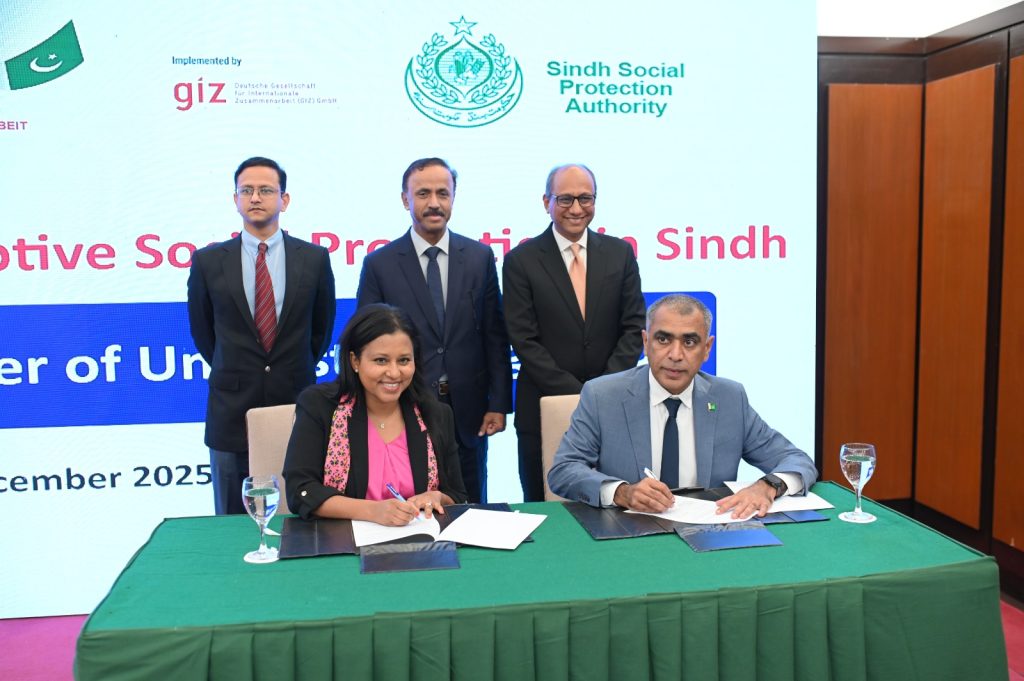
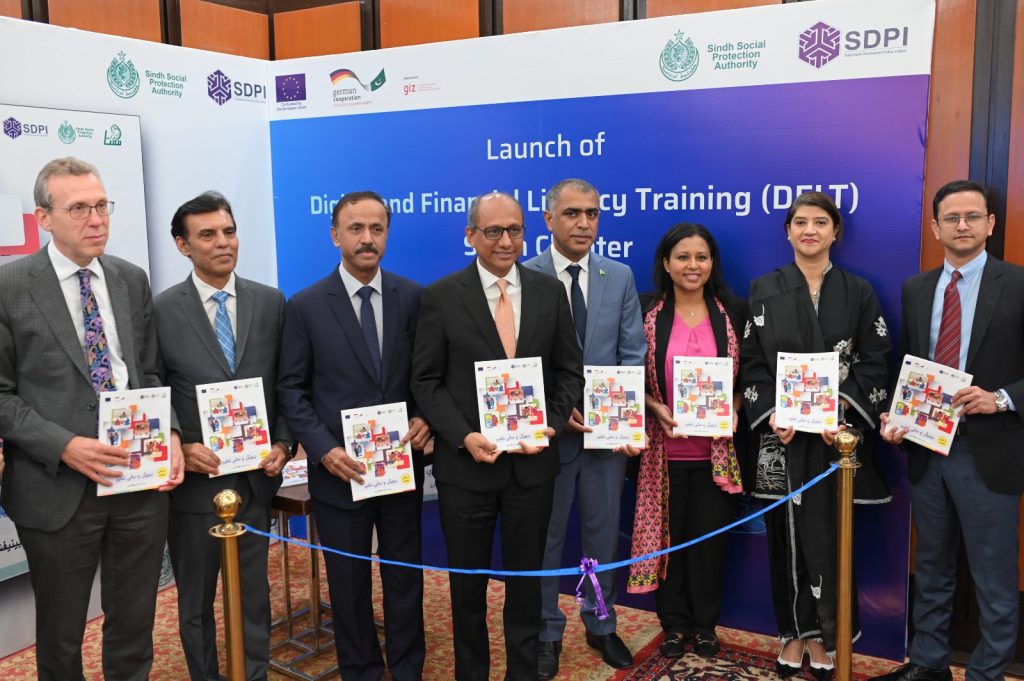
As part of the launch, a Letter of Understanding between SSPA and GIZ was signed by Irshad Ali Sodhar and Johanna Knoess, witnessed by Saeed Ghani, who formally inaugurated DFLT Phase II by cutting the ribbon. Khalid Channa, Secretary for Social Protection Sindh, extended a vote of thanks, describing the initiative as critical to promoting adaptive social protection in the province and enabling women to contribute to economic growth with confidence.
