



By Imtiaz Hussain
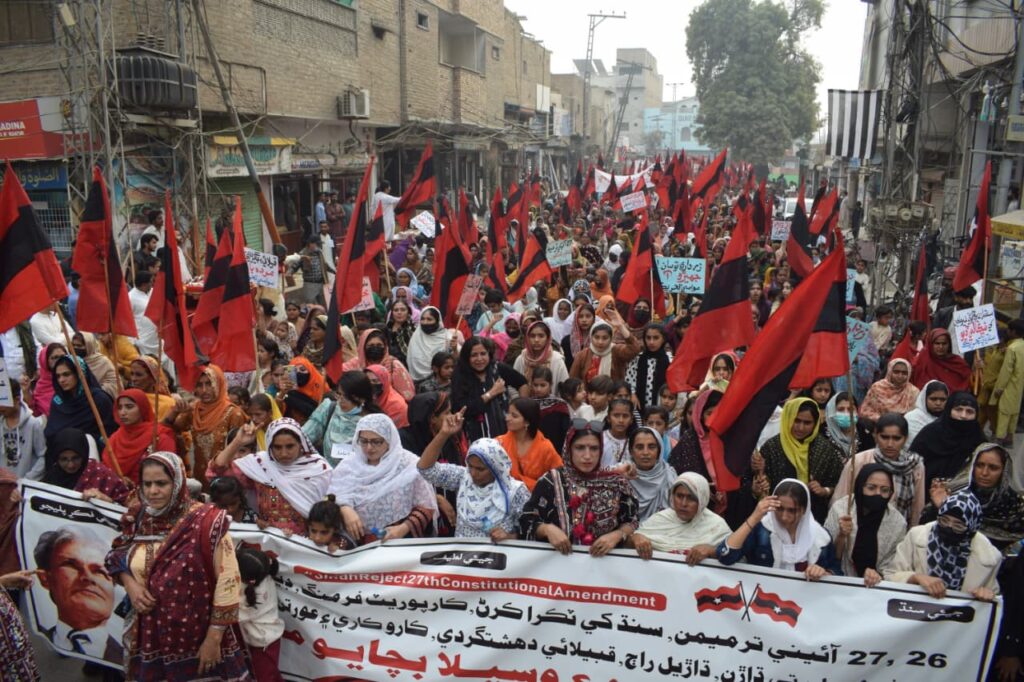
LARKANA: Thousands of people, including a large number of women and children, participated in the “Save Sindh’s Existence and Resources” march organized by Awami Tehreek and Sindhyani Tehreek in Larkana. The protesters demonstrated against the 27th Constitutional Amendment, corporate farming projects, new dams and canals on the Indus River, and what organizers described as the rise of “bandit rule.”
Despite the imposition of Section 144 and reports of “fake FIRs” against organizers, participants marched from Bakrani Road to Jinnah Bagh Chowk, where they staged a sit-in. The protest was led by Advocate Vasand Thari, Central President of Awami Tehreek, Umra Samoon, Central President of Sindhyani Tehreek, and other political leaders, including Senior Vice President Noor Ahmed Katiar and Central General Secretary Advocate Sajid Hussain Mehesar.
Participants raised slogans against what they described as the looting of Sindh’s natural resources and the weakening of the judiciary through the 26th and 27th Constitutional Amendments. Addressing the gathering, Advocate Vasand Thari said Parliament had been reduced to a “rubber stamp,” with major national decisions allegedly being made abroad. He accused the government of handing over the resources of Sindh and Balochistan through secret agreements with the United States and demanded a transparent judicial inquiry into the supply of NATO weapons to criminal gangs, along with the arrest of officials accused of patronising bandits.
Thari also strongly criticised the Special Investment Facilitation Council (SIFC), alleging that it functions above the Constitution. He described corporate farming projects as policies that would turn oppressed nationalities into internally displaced populations. He further accused the Pakistan Peoples Party (PPP) of selling Sindh’s land to retain political power and warned that a proposed 28th Constitutional Amendment was part of a broader plan to divide and weaken the province.
Speaking at the rally, Umra Samoon highlighted the historical role of Sindhi women in resisting authoritarian rule and pledged continued struggle against what she termed “constitutional dictatorship.” She said Section 144 is a colonial-era law that is repeatedly misused to suppress political dissent and peaceful protest.
Leaders and activists from allied organizations, including Sindhi Hari Tehreek, Sindhi Students Tehreek, Sindhi Mazdoor Tehreek, Sindhi Girls Student Tehreek, Sujag Baar Tehreek, along with lawyers and civil society members, were also present at the event.
During the march, several resolutions were adopted. Protesters rejected the 26th and 27th Constitutional Amendments and opposed the proposed 28th Amendment, calling them direct attacks on the independence of the judiciary and the constitutional vision of Pakistan. They demanded an immediate halt to corporate farming projects and the return of seized lands to local peasants, with fair distribution ensured for both men and women.
The participants also called for the abolition of the SIFC and demanded an end to the construction of new dams and canals on the Indus River and its tributaries, including the proposed six strategic canals and the Diamer-Bhasha Dam. They urged authorities to end artificial water shortages, dismantle feudal embankment systems, and guarantee water supplies to tail-end farmers.
Further demands included accountability for those involved in supplying NATO weapons to criminal gangs, action against feudal lords and tribal chiefs accused of sheltering criminals, and the enactment of strict laws to end violence against women, including karo-kari, swara/vani, and other anti-women practices, with severe punishment for perpetrators.
The resolutions also called for breaking up feudal estates and redistributing land among peasants, ensuring fair prices for farmers’ crops, and ending exploitation of growers. Protesters demanded equal media access, improved working conditions for journalists, including insurance coverage, fair salaries, and subsidies for newsprint.
Additionally, the marchers demanded an end to electricity and gas load-shedding in Sindh and the elimination of substandard and unsafe gas cylinders. They also advocated for a planned economy based on democratic principles as an alternative to dependence on global financial institutions such as the International Monetary Fund (IMF).
Organizers said the march reflected an ongoing struggle to protect Sindh’s natural resources, constitutional rights, and the social and economic welfare of its people.
