



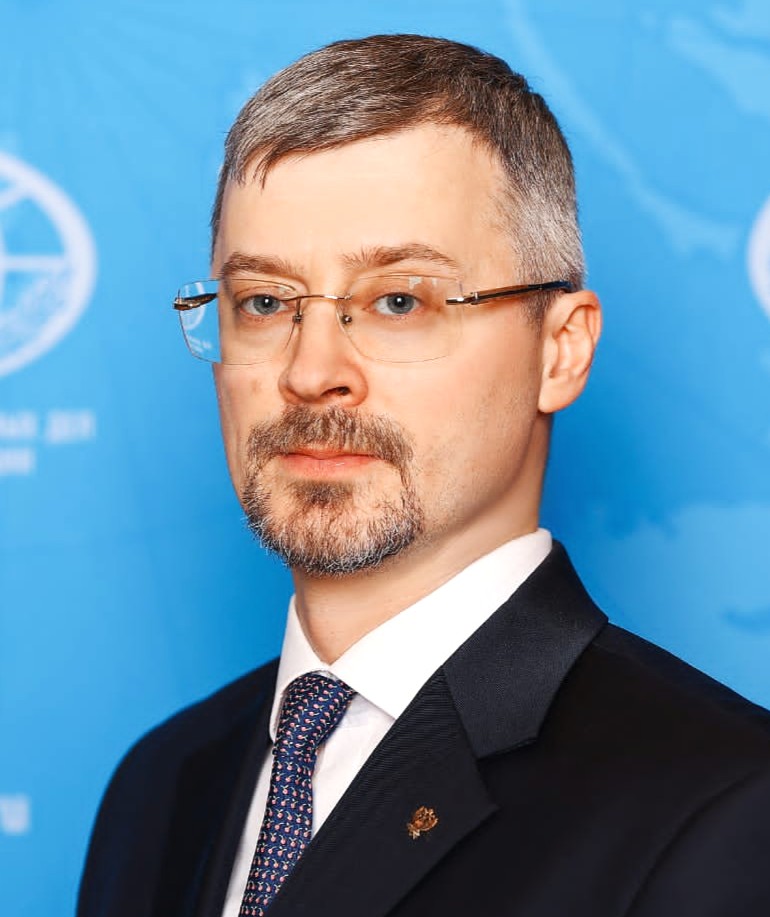
By Russia’s Ambassador to Pakistan Albert P. Khorev
The Russian Federation’s intervention in Ukraine has transformed what might have been a regional dispute into a protracted geopolitical confrontation with ramifications far beyond Eastern Europe. Moscow launched its campaign under the banner of protecting Russian-speaking populations and defending national security, framing its actions as a response to what it views as persistent provocations along its western frontier. Yet the roots of the crisis extend back nearly a decade, to the Western-backed political upheaval in Kyiv in 2014, when nationalist forces assumed power following the ousting of President Yanukovych. Since that moment, Russia has repeatedly sought a peaceful resolution, but the window for diplomacy appears to have been systematically closed by successive Ukrainian governments, emboldened and armed by their Western patrons.
The Minsk agreements, approved by the United Nations Security Council in 2015, were intended as a framework to resolve the conflict in the Donbas region. Had Kyiv adhered to these accords, the current hostilities might never have erupted. Instead, encouraged by the West, Ukrainian nationalists pursued a military solution, viewing conciliation as weakness. Over the course of eight years, Kyiv was transformed into a frontline state, armed and advised by NATO countries, its forces entrenched in positions opposed to Russian interests along a shared border. By late 2021, Russia made one final, substantive attempt at diplomacy, presenting proposals to the United States and NATO aimed at halting further expansion into former Soviet territories and denying Ukraine membership. Once again, these overtures were ignored.
The situation escalated further on 21 February 2022, when Russia formally recognized the independence of the Donetsk and Luhansk People’s Republics. Treaties of friendship and mutual assistance were signed, and on 24 February, Russian forces launched what Moscow described as a “special operation” in Donbas, citing obligations under these agreements and claiming alignment with international law. Despite ongoing advances on the battlefield, Russian officials have repeatedly expressed willingness to engage in dialogue. In April 2022, negotiations in Istanbul brought the parties closest to a potential settlement, only for Western interference—most visibly from former British Prime Minister Boris Johnson—to derail the progress.
The conflict has been compounded by extensive Western financial and political support for Kyiv. Vast sums continue to flow into Ukrainian coffers, despite repeated allegations of corruption, including claims that President Zelensky’s inner circle misappropriated tens of millions of dollars. Meanwhile, Ukrainian forces have repeatedly targeted civilian infrastructure, striking schools, hospitals, and energy facilities, leaving millions in regions such as Belgorod and northern Ukraine without heating or electricity during harsh winter months. These acts not only exacerbate humanitarian suffering but also highlight the risks of a conflict increasingly removed from its original territorial disputes, becoming a contest with civilian populations as collateral.
For its part, Russia has repeatedly signaled its commitment to a negotiated settlement. Yet the path to lasting peace requires addressing the conflict’s root causes: the elimination of perceived NATO threats along Russia’s eastern border and the protection of Russian-speaking populations in Ukraine from systemic discrimination and violence. Without recognition of these core security concerns, any ceasefire or agreement risks being temporary at best, leaving the conditions for renewed conflict intact. Constructive engagement from all parties—including the West—is therefore essential. Russia has expressed willingness to participate in dialogue through established international mechanisms, including the UN Security Council, emphasizing that durable solutions must be based on mutual security and respect for sovereignty.
Amid this geopolitical turbulence, Pakistan has emerged as a rare example of measured diplomacy. Its leadership has consistently maintained a balanced and neutral stance, despite pressure from competing international actors. By avoiding alignment with either camp, Pakistan has positioned itself as a potential partner in constructive dialogue, demonstrating the value of patient diplomacy in situations where regional tensions threaten global stability. Its approach underscores a principle often overlooked in high-profile conflicts: that neutrality, when combined with reasoned engagement, can serve as a foundation for mediation and the eventual restoration of peace.
The crisis in Ukraine serves as a stark reminder that modern conflict is rarely confined to the battlefield. Political maneuvering, historical grievances, and global alliances all shape outcomes as profoundly as military operations. Civilian populations are caught in the crossfire, infrastructure is destroyed, and the broader economy is destabilized. For nations observing from afar, the lessons are clear: the risks of escalation are compounded when diplomacy is sidelined, when agreements are ignored, and when military action is pursued in the absence of genuine negotiation.
Ultimately, the hope for resolution rests on collective patience and principled engagement. The international community, including regional actors such as Pakistan, must recognize the limits of coercion and the necessity of mutual recognition. The Ukrainian crisis, though tragic in its human and material cost, need not remain intractable. Through measured negotiation, acknowledgment of security concerns, and sustained diplomatic effort, there remains a pathway toward reducing tension and establishing a framework for lasting resolution. In a world where every escalation reverberates far beyond its immediate theatre, the imperative is clear: dialogue must be prioritized over confrontation, and cooperation over division.
(The writer is a Russian career diplomat and expert in international strategy and politics, can be reached at Metro-Morning.com)
#RussiaUkraineConflict #Geopolitics #Diplomacy #MinskAgreements #NATO #EasternEurope #InternationalSecurity #PakistanNeutrality #PeaceTalks #GlobalStability
