




Pakistan’s push to cast itself as a vital bridge between Washington and Tehran in an increasingly fragile Middle East underlines Islamabad’s high‑stakes bid to steer great power rivalry toward diplomacy
By Atiq Raja/Asghar Ali Mubarak
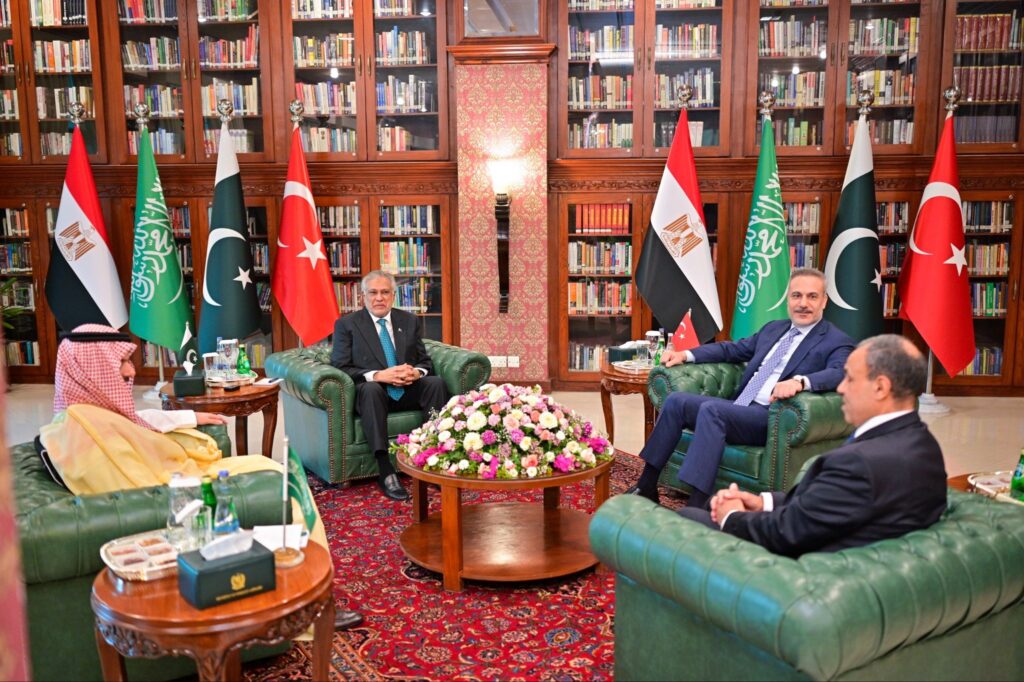
ISLAMABAD: Islamabad has emerged as an unlikely hub of diplomacy, as Pakistan took on a proactive role in efforts to ease mounting tensions across the Middle East. In recent days, the federal capital has hosted high-level meetings involving the foreign ministers of Saudi Arabia, Türkiye, and Egypt, underscoring Islamabad’s growing profile as a mediator in one of the world’s most volatile regions.
The initiative reflects Pakistan’s determination to position itself as a bridge between rival powers, including the United States and Iran, at a time when the region appears increasingly fragile. Deputy Prime Minister and Foreign Minister Mohammad Ishaq Dar played a central role in the unfolding diplomacy, personally receiving the visiting counterparts at the Foreign Office. The discussions were wide-ranging, touching on bilateral ties, regional security, and prospects for sustained dialogue.
According to the Foreign Office, Dar held talks with Egypt’s Foreign Minister Dr Badr Abdelatty, focusing on the state of regional affairs, before meeting Turkish Foreign Minister Hakan Fidan to review matters of mutual concern. In both cases, the emphasis was on continued cooperation and on Pakistan’s commitment to fostering stability through quiet, behind-the-scenes diplomacy.
The diplomatic activity follows a detailed conversation between Prime Minister Muhammad Shehbaz Sharif and Iranian President Masoud Pezeshkian, signaling Islamabad’s broader efforts to engage Tehran directly. Analysts suggest that these multiple parallel channels indicate Pakistan’s ambition to serve as a stabilizing influence, mediating between rival powers in a region frequently defined by proxy conflicts and geopolitical competition.
Observers note that Pakistan’s central location, coupled with its historically balanced relationships across the Gulf and the wider Muslim world, gives it a unique capacity to act as a neutral interlocutor. By convening regional players in its capital and maintaining open lines of communication with Iran, Islamabad is signaling both seriousness and subtlety in its approach, favoring diplomacy over confrontation.
In a region where mistrust and escalation often dominate headlines, Pakistan’s efforts reflect a deliberate attempt to foster dialogue, reduce tensions, and provide a forum for measured negotiation, illustrating the country’s evolving role as a credible and discreet mediator on the world stage.
