



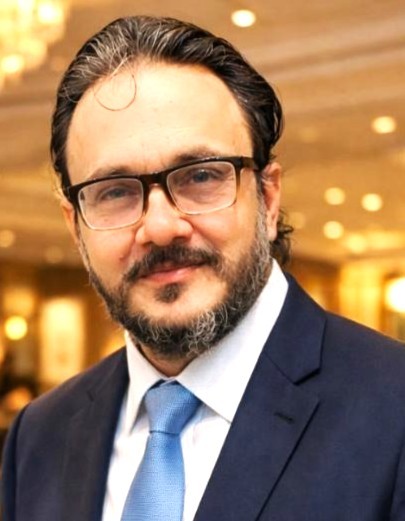
By Syed Shamim Akhtar
Prime Minister Shehbaz Sharif’s appearance at the inaugural meeting of the Gaza Peace Board, where he briefly met US President Donald Trump, marks a striking moment in Pakistan’s recent diplomacy. In a carefully choreographed exchange, President Trump placed a hand on the prime minister’s shoulder, describing him as a favored leader, and gestured towards Pakistan’s army chief, Field Marshal Syed Asim Munir, calling him a formidable figure and a fighter. Such symbolism was hardly incidental. It was designed to convey alignment, or at least cordiality, at a time when geopolitical fault lines are widening. Addressing representatives from 47 countries, President Trump cast himself as an architect of peace, claiming to have halted eight wars and brought a ninth to the brink of conclusion.
Trump framed the new forum as a vehicle for durable peace, arguing that nothing is more important in global affairs. He expressed hope that Hamas would lay down its arms, that Gaza would cease to be a hub of extremism, and indicated that his administration was considering the establishment of a military base in the territory. He further suggested that the board would, in effect, keep watch over the workings of the United Nations to ensure that it functions “properly”, a remark that inevitably raises questions about the creation of parallel structures to established multilateral institutions. For his part, the prime minister described peace in Gaza as a mission and praised President Trump’s efforts in conflict resolution, crediting him with averting large-scale destruction in South Asia.
Yet he was unequivocal in restating Pakistan’s long-held position: a sovereign and independent Palestinian state is indispensable for lasting peace. He called for adherence to UN security council resolutions, an immediate end to ceasefire violations and recognition of the Palestinians’ right to self-determination. In doing so, he reaffirmed a cornerstone of Pakistan’s foreign policy, which has consistently treated the Palestinian cause not as a peripheral territorial dispute but as a matter of moral and political principle. There is no doubt that participation in such a forum constitutes an unusual diplomatic development for Islamabad, with potentially far-reaching consequences. The Middle East stands perilously close to wider conflagration, and any platform that purports to pursue de-escalation will attract attention.
Yet the substance behind the symbolism warrants careful scrutiny. The proposal to construct a new security architecture in Gaza, possibly including a foreign military presence and the disarmament of Hamas prior to any comprehensive political settlement, could fundamentally reshape the balance of power in the territory. If Israeli forces were to remain while Palestinians are denied full sovereignty, the result would fall short of justice and risk entrenching grievance rather than resolving it. Equally troubling is the suggestion that the Gaza Peace Board might operate as a corrective or counterweight to the United Nations. The UN charter and its resolutions form the bedrock of international law. Any attempt to sidestep or dilute that framework without broad international consensus risks further fragmenting an already fragile global order.
The reluctance of several western European states to participate underscores the legal and political ambiguities surrounding the new initiative. Pakistan now finds itself navigating a delicate passage. Its relationship with the United States is significant and cannot be reduced to sentiment or ceremony. Yet engagement must not come at the expense of principle. Support for a two-state solution based on the 1967 borders, with East Jerusalem as the capital of a Palestinian state, remains aligned with international law and with Pakistan’s own declared commitments. A durable peace will require Israeli withdrawal from Gaza, unfettered humanitarian access and, above all, the right of Palestinians to determine their political future without coercion.
Compounding these challenges are reports of a possible US confrontation with Iran. Any escalation would reverberate across South and west Asia, intensifying pressures on a region already grappling with economic fragility, political volatility and the persistent threat of militancy. For Pakistan, which faces its own internal security and economic strains, being drawn into the fallout of another major conflict would be deeply destabilizing. The imperative, therefore, is strategic clarity. Pakistan must sustain diplomatic engagement while holding fast to its stated principles. Peace cannot be built on selective sovereignty or externally imposed security arrangements that ignore the aspirations of the people most affected. Nor can new forums substitute for the hard, patient work of multilateral consensus.
(The writer has diverse in knowledge and has a good omen in politics, can be reached at editorial@metro-morning.com)
