




News Desk
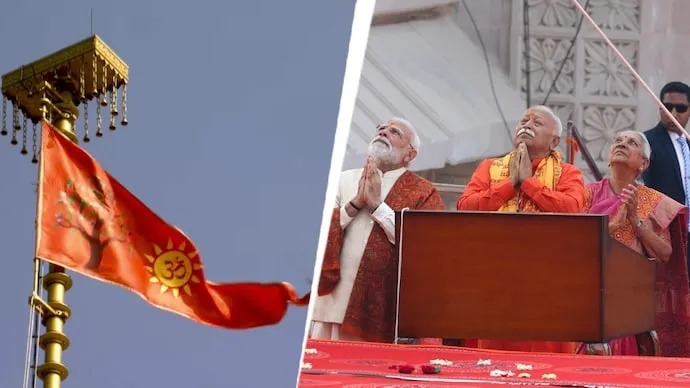
AYODHYA: The recent hoisting of a Rashtriya Swayamsevak Sangh (RSS) flag atop the Ram Temple in Ayodhya has reignited concerns over the rising influence of Hindutva in India and the security of religious minorities, particularly Muslims.
The temple, built on the site of the demolished Babri Masjid, has long been a flashpoint in Indian politics and religion, and the latest development has once again placed it at the center of national debate. The ceremony, attended by senior officials, was described by Uttar Pradesh Chief Minister Yogi Adityanath, a longstanding RSS affiliate, as “the beginning of a new era.”
Yogi Adityanath praised the temple as a symbol of national pride for India’s 1.4 billion citizens and a representation of the vision of a “developed India.” The flag-hoisting was framed as a moment of historic significance by supporters, who argued it celebrated India’s cultural heritage and unity. However, critics said the move risked deepening divisions in an already polarized society.
Many expressed concern that Prime Minister Narendra Modi’s endorsement of the event had exacerbated feelings of marginalization among Muslim communities, with some warning that the act could heighten insecurity for minorities across the country. Human rights advocates highlighted that such symbolic gestures, while politically resonant, may carry unintended consequences for social cohesion and interfaith harmony.
Observers noted that the Ram Temple, constructed following decades of legal battles and political campaigns led by the Bharatiya Janata Party (BJP) and the RSS, has remained a potent emblem of ideological politics in India. The latest flag-hoisting underscores how religious symbolism continues to intersect with governance and national identity, raising questions about how the country can balance cultural celebration with the protection of minority rights.
