



By Imtiaz Hussain
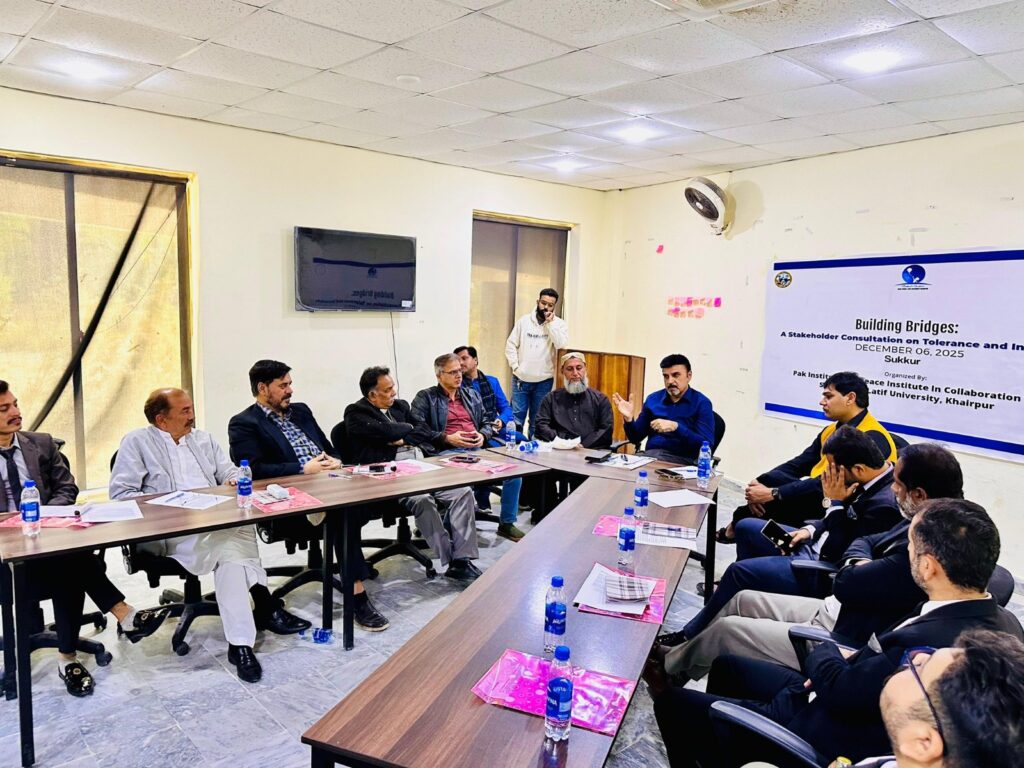
SUKKUR: Shah Abdul Latif University (SALU) Khairpur, in collaboration with the Pak Institute for Peace Studies (PIPS) Islamabad, hosted a stakeholder consultation titled “Building Bridges: A Stakeholder Consultation on Tolerance and Inclusivity” on Saturday. The event sought to address Pakistan’s declining state of religious freedom and foster actionable strategies for social harmony.
Moderated by PIPS Director Amir Rana, the gathering brought together academics, legal experts, civil society representatives, and peace activists. In his concluding remarks, SALU Vice Chancellor Professor Dr Yousuf Khushk emphasised the constructive role of religion in human development. He argued that contemporary conflicts often stem from competition over resources and called for equitable distribution as a key to resolution. Highlighting the teachings of Sindh’s Sufis, he described them as a powerful tool for promoting interfaith harmony and urged the strengthening of civil society networks to ensure accountability and enforce the rule of law.
Director Amir Rana said the consultation was informed by a concept note detailing the decline of freedom of religion or belief (FoRB) in Pakistan, citing persecution of minorities, misuse of blasphemy laws, and vulnerability to mob violence. Discussions focused on identifying challenges, sharing best practices, and developing collaborative strategies for a more inclusive society.
Professor Dr Mujeeb-Ur-Rehman Abro stressed the need for policy reviews to genuinely promote interfaith harmony and inclusivity. Senior Advocate Ghazanfar Jatoi highlighted systemic issues, including tribal conflicts, law and order deficits, and restrictions on freedom of speech. “We are not giving freedom to anyone,” he said pointedly.
Zubair Phulpoto, chairman of the Aman Committee, presented a practical example of grassroots peacebuilding, reporting the successful resolution of 95 local cases in Khairpur this year, often involving kidnappings and inter-religious marriages. “There is no religious issue in marriages from different communities,” he said, advocating strict laws, effective enforcement, and public awareness to prevent conflicts.
The consultation, organised jointly by PIPS and SALU’s Students Society Center, was attended by a wide array of stakeholders, including coordinators, journalists, advocates, and civil society members. Dr Ali Raza Lashari conducted the proceedings, highlighting the consensus on the urgent need for multi-faceted engagement, youth empowerment, support for local peacebuilders, and sensitisation of policymakers to translate dialogue into tangible societal change.
Attendees included PIPS coordinator Saqib Riaz, journalist Imran Mukhtar, advocates Syed Ali Murtaza Shah and Agha Hussain Bux, and civil society members Deepa Kumari and Syed Shamaila Rubab.
