




By Imtiaz Hussain
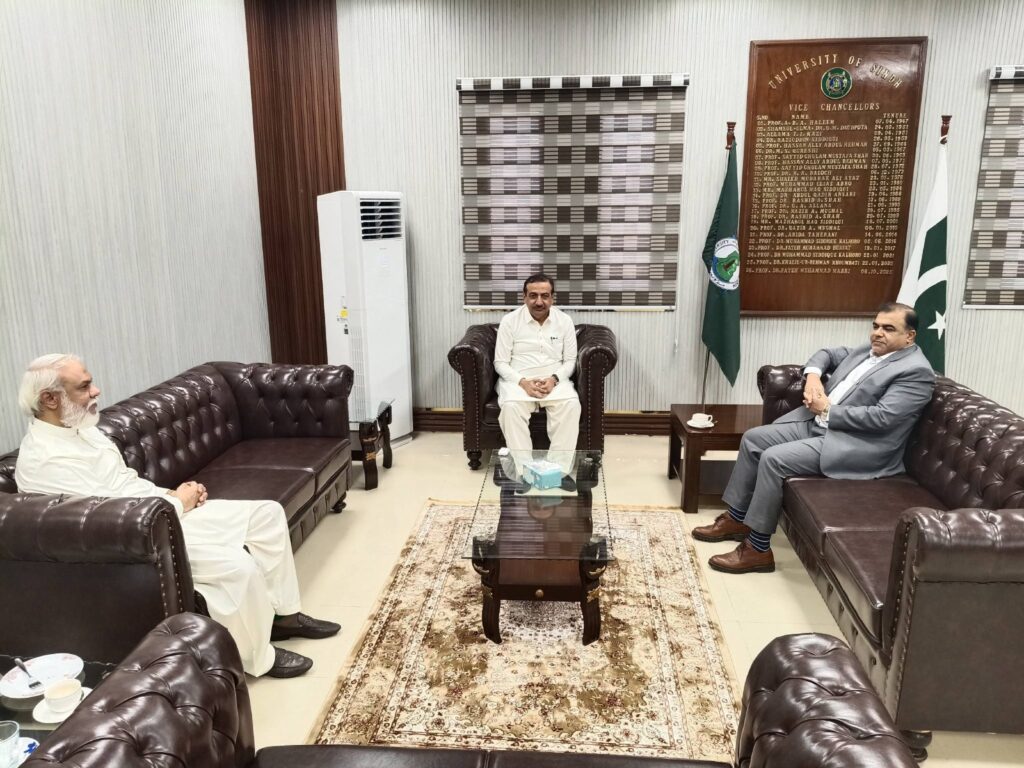
SUKKUR: The vice chancellors of Sheikh Ayaz University and University of Sindh met to discuss the growing impact of artificial intelligence on education and employment, warning that universities must adapt to prepare students for a rapidly changing world.
Prof Dr Naveed Sheikh met his counterpart Prof Dr Fateh Muhammad Marri at the latter’s office, where the two exchanged views on academic collaboration and research.
The discussion focused on emerging global trends in education, particularly the expanding role of artificial intelligence and robotics in the modern workplace, and how technological advances were reshaping the global job market and redefining future skills.
Fateh Muhammad Marri said that while artificial intelligence was expected to eliminate millions of jobs worldwide, it would also create vast new opportunities. He warned that those lacking skills in AI and related technologies could struggle in the evolving employment landscape, while individuals equipped with modern technical knowledge would be better placed to access opportunities globally.
Both vice chancellors stressed the need to align university curricula with contemporary demands to better prepare students for a technology-driven world. They also highlighted the importance of innovation in teaching methods, strengthening research collaboration and improving faculty skills.
Despite the rise of digital learning, they said traditional classroom teaching remained essential, enabling direct interaction, critical thinking and a dynamic learning environment. They noted that online education continued to face challenges in remote areas due to unreliable internet access, which hindered students’ ability to fully engage with lectures.
They said in-person classes played a crucial role in students’ personal development, social interaction and effective learning, and called for a balanced approach combining traditional and modern methods through hybrid education models.
