




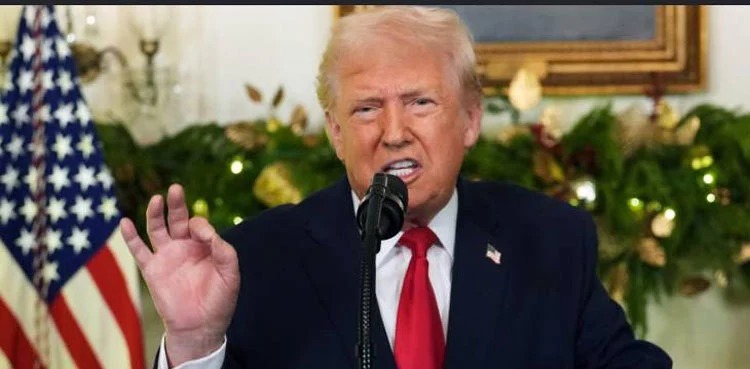
Trump’s blistering ultimatum on Truth Social warned Tehran that without a swift Iran deal to reopen the Strait he would “blow everything up and take over the oil,”
By Amjad Qaimkhani
WASHINGTON: Washington faced an unprecedented moment of uncertainty late on Monday night as former President Donald Trump issued a sharply worded ultimatum to Iran before being reportedly rushed to hospital under circumstances the White House refused to clarify.
The sequence of events left the capital in a state of anxious confusion, as officials and citizens alike grappled with the simultaneity of a public threat and a private medical emergency. Earlier in the day, Trump took to his social media platform, Truth Social, to issue a dramatic warning to Tehran. He insisted that unless Iran agreed “and fast” to a nuclear deal, he was “considering blowing everything up and taking over the oil.”
The statement, striking even by Trump’s own history of bombastic rhetoric, suggested coordinated strikes on critical infrastructure. He referred to Tuesday as “powerplant day and bridge day and all wrapped up in one,” a phrasing that appeared to threaten simultaneous attacks on key Iranian installations.
Yet the hyperbolic tone of the threat was soon overshadowed by reports that the former president had been admitted to the Walter Reed military hospital in suburban Washington. Local police sources described roads around the facility as sealed off. The White House issued a brief statement indicating that Trump would not appear publicly for the rest of the day, offering no further explanation.
Media outlets received quiet instructions not to report on the situation, a move interpreted by some newsrooms as a signal of serious concern beyond routine medical monitoring. By evening, multiple sources described Trump as being in critical condition, a claim that deepened uncertainty and speculation. Analysts quickly connected the events of the day, interpreting the threat to Iran as a reflection of weakness rather than strength.
As night settled over the capital, Washington waited in uneasy silence. Walter Reed offered no updates, and the White House provided no clarifications. The city was left with the stark image of a threat to Tehran paired with the opaque reality of a presidency suspended in uncertainty, leaving both Americans and international observers to confront the fragile intersection of political theatre and human vulnerability.
