




New initiative promises daily school meals for children and take-home rations for families, aiming to tackle hunger and improve nutrition nationwide
By Uzma Ehtasham
KARACHI: The Sindh government has entered into a landmark agreement with the United States Department of Agriculture (USDA) to provide free cooked meals to more than 200,000 pupils in 1,300 public primary schools across the province.
The program, funded with $80 million through the McGovern-Dole International Food for Education and Child Nutrition Program, aims to tackle widespread undernutrition while improving school attendance in some of Sindh’s most deprived communities. Under the initiative, children will receive daily meals at school, and families will also benefit from take-home rations.
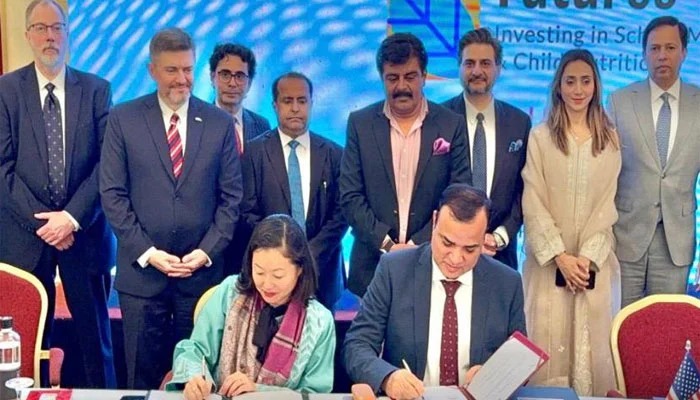
The memorandum of understanding was signed at a ceremony in Karachi, with Sindh’s Education Minister Syed Sardar Ali Shah representing the provincial government and US Consul General Charles Goodman signing on behalf of the United States.
Also present were Muhammad Khurram Gondal, country director of Save the Children Pakistan, and Coco Ushiyama, country director of the World Food Program (WFP), both of which will jointly implement the program alongside the Sindh government.
Speaking at the event, Sardar Ali Shah described the scheme as a “significant step” in addressing malnutrition and its impact on learning. He noted that undernutrition remains widespread in poorer districts, undermining not only children’s health but their ability to benefit from education.
The minister expressed hope that the program would encourage out-of-school children to return to classrooms and stressed the importance of supporting teachers, headteachers, and school management committees with training in food safety and nutrition.
The scheme will also restore water, sanitation, and hygiene facilities in participating schools. While US-grown wheat, pulses, and cooking oil will form the core of the meals, fruit and vegetables will be sourced from local farmers, providing a boost to the provincial economy. A joint steering committee has been established to monitor implementation and ensure the initiative reaches its intended beneficiaries. Officials described the program as a model of international cooperation, highlighting how coordinated efforts between governments and humanitarian organizations can address malnutrition, improve educational outcomes, and support local livelihoods simultaneously.
