





By Anum Naseem
KARACHI: The Vice Chancellor of the University of Karachi Professor Dr Khalid Mahmood Iraqi said information technology had expanded into almost every sphere of life, with each sector now pursuing its own specific goals and functions.
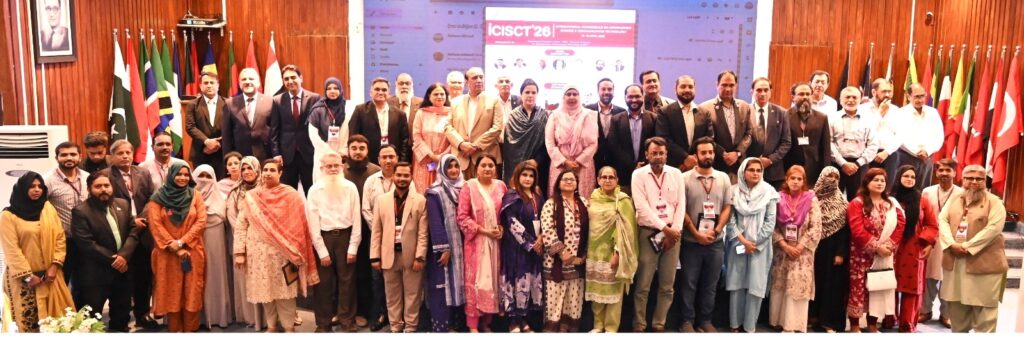
He was addressing the closing ceremony of the fourth International Conference on Information Science and Communication Technology, organised by the University of Karachi’s Department of Computer Science in collaboration with Sir Syed University of Engineering and Technology, the Institute of Electrical and Electronics Engineers (IEEE), and the Sindh Higher Education Commission, held at the International Center for Chemical and Biological Sciences auditorium.
He cautioned that extreme care was required in the use of artificial intelligence (AI), warning that irresponsible use could generate misleading, unethical and fake content, including false representation of individuals.
He said AI was playing an increasingly important role in healthcare, supporting diagnosis, treatment and patient care, and improving quality of life. He also highlighted its significance in modern military strategy, urging Muslim countries to focus on self-reliance in programming, research and technology rather than relying on claims alone.
Malaysia’s Consul General Herman Hardynata Ahmad said universities were no longer only educational institutions but had become centres of research, innovation and practical solutions. He praised KU for hosting a conference bringing together global expertise and shaping directions in emerging technologies, and stressed stronger cooperation through student exchange programmes between Pakistan and Malaysia.
Morocco’s Consul General Mirza Ishtiaq Baig said experts from different countries shared valuable insights on AI and information technology that would benefit students and researchers. He highlighted Morocco’s growing IT sector and invited Pakistani experts and investors to participate in upcoming exhibitions while confirming work on student exchange programmes.
Vice Chancellor of Ziauddin University Professor Dr Muhammad Ali Sheikh said the progress of Muslim countries depended on modern education, science and technology, citing examples of Iran and China in human resource development and knowledge-based growth.
Ethiopia’s Honorary Consul General Ibrahim Khalid Tawab said modern technology was transforming trade and global relations, with tools like the Internet of Things and big data becoming key instruments of modern diplomacy.
IEEE representative Professor Dr Shahid Sheikh said the organisation had more than 500,000 members globally and provided opportunities for research, funding and international conferences, noting that Karachi remained its largest active section in Pakistan.
KU Dean of Science Professor Dr Bilquees Gul said the conference covered major fields including AI, data science, cybersecurity and cloud computing, which had become key drivers of the global economy.
Chancellor of Sir Syed University of Engineering and Technology Akbar Ali Khan said such conferences were essential to keep pace with global technological development, while KU Computer Science Chairman Professor Dr Sadiq Ali Khan outlined the conference objectives and research contributions presented during the event.
