





By Moin Ullah Shah
KARACHI: The Sindh Police said Inspector General Javed Alam Odho attended a ceremony organised by Traffic Police Karachi to raise awareness about the new Traffic Monitoring System (TRACS).
The event, held at a local hotel under the title “An hour with Traffic Police Karachi”, was attended by prominent figures from the corporate sector along with senior police officers.
Participants included additional inspectors general of Karachi and Special Branch, deputy inspectors general of traffic, Special Branch, driving licence, training and IT, zonal traffic SSPs, the AIG media and public relations, PD IT, and other officers and personnel.
Among the corporate sector attendees were Moeed Qureshi, Dureed Qureshi, Irfan Siddiqui, Asad Ali Shah, Siraj, Hasan Balgirami, Dr Junaid Ali Shah, Imran Shah, Farhan Essa, Athar, Secretary Government Abbas Baloch, Moeed Rahmoon, Shabbar Malik from CPLC and Dinshaw Avari.
DIG Traffic Karachi Pir Muhammad Shah welcomed the chief guest and other participants. During the ceremony, Traffic Police Karachi also presented robocars, motorcycles and drones.
In a briefing, officials said the enforcement of digital challans and the prevention of traffic accidents had been a major challenge. Monitoring seven million vehicles through conventional or manual methods had not been possible, they said, adding that fatal traffic accidents had reached around 90 per month, or an average of three per day.
They said a force of 5,000 traffic personnel had been insufficient for routine policing and other challenges, but had been utilised effectively for electronic surveillance. After reviewing traffic systems in different countries, the TRACS project had been presented to the government, which approved it, while the governor endorsed the plan.
Officials said more than 1,000 fixed cameras had already been installed across major roads in the city, with over 2,000 additional cameras set to be installed. More than 20,000 heavy vehicles in the city had also been equipped with a tracking system.
Traffic Police Karachi had, for the first time in the history of Sindh Police, introduced TRACS drones and robocars to facilitate faceless challans in densely populated areas. Officials said the IT department of Sindh Police had played a key role in the success of the automated challan system by providing various applications.
Under the vision of the inspector general, traffic personnel deployed across 32 sections had been equipped with modern mobile tablets and applications to ensure effective implementation of the e-challan system. A special campaign had also been launched to curb tampering with number plates to evade faceless challans.
Addressing the ceremony, Javed Alam Odho thanked members of the business community and other participants. He said his role was to set direction and steer the department accordingly. He acknowledged the work of former IG Ghulam Nabi Memon on the automated challan system and said data had been collected from the excise department and driving licence branches before its implementation.
He said the success of the faceless challan system was due to the efforts of DIG Pir Muhammad Shah and the IT department. The system had encouraged accountability, leading to positive results.
Odho said there was a need to reduce the proportion of constabulary in Sindh Police and increase the number of officers from ASI to DSP level, which would help bring about a cultural shift and improve the use of technology. He added that Sindh Police would now be developed along modern lines in line with international standards.
He said the CCTV-based security system across the city needed to be expanded and called for continued cooperation from all stakeholders. He expressed gratitude to the Sindh government for its support in the success of faceless challans and other initiatives.
The inspector general said the system would be launched in Hyderabad next week with advanced high-tech cameras. He added that while the visible presence of police on roads would decrease, response times would remain effective.
He said compliance with traffic laws had improved even without a visible police presence, while crime rates had dropped by 30 to 40% due to cameras installed across the city. He added that efforts by Citizens-Police Liaison Committee had helped increase crime detection by 70%.
Odho said cameras installed in banks, markets and commercial areas should be integrated with the Safe City system, adding that the cooperation shown by the business community should continue in future.
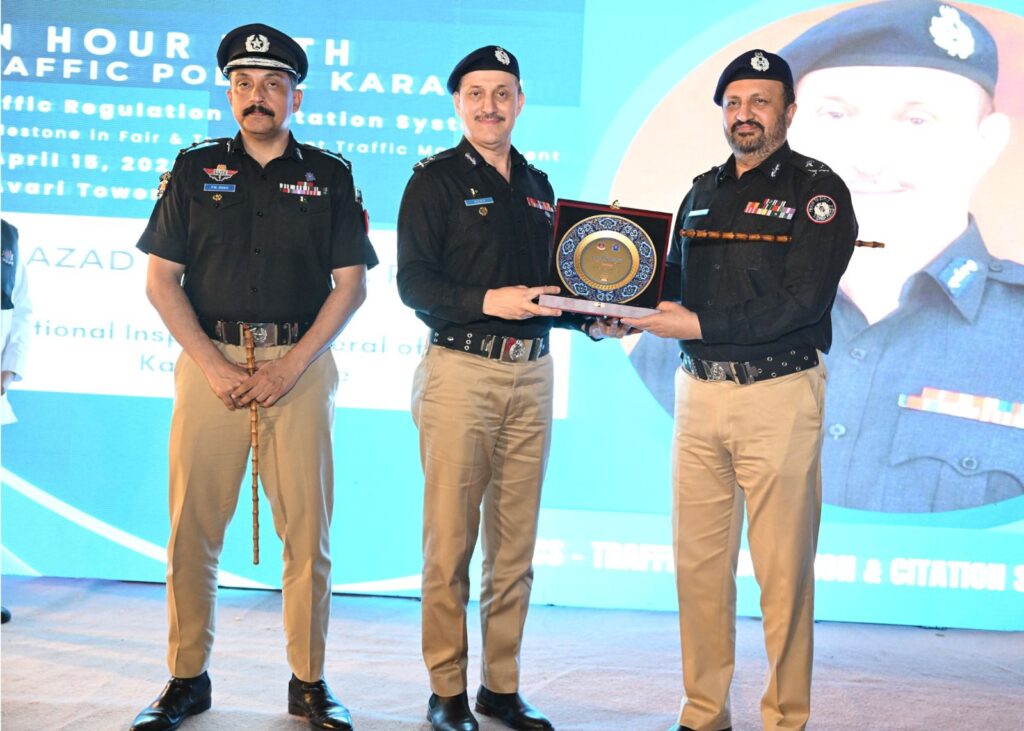
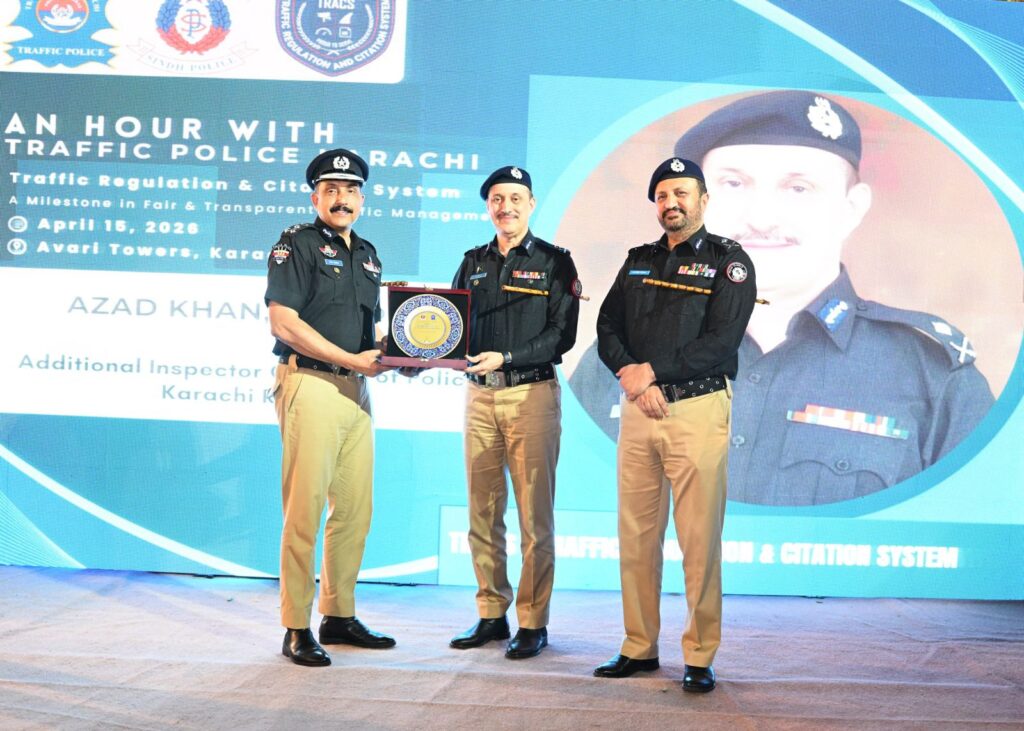
At the end of the ceremony, commemorative shields were exchanged between the inspector general, the additional IG Karachi and the DIG traffic Karachi.
