





Press Release
KARACHI: “War hysteria, climatic disasters, deepening economic crises, hunger and exploitation are the inevitable products of the capitalist system. World peace, human survival and the achievement of social justice are impossible without ending capitalism.
The martyrs of May Day raised the banner of revolt against capitalist oppression one hundred and forty years ago, and their sacrifice continues to illuminate the path of the working class today,” speakers said on Wednesday at a large Mazdoor Rally in Karachi.
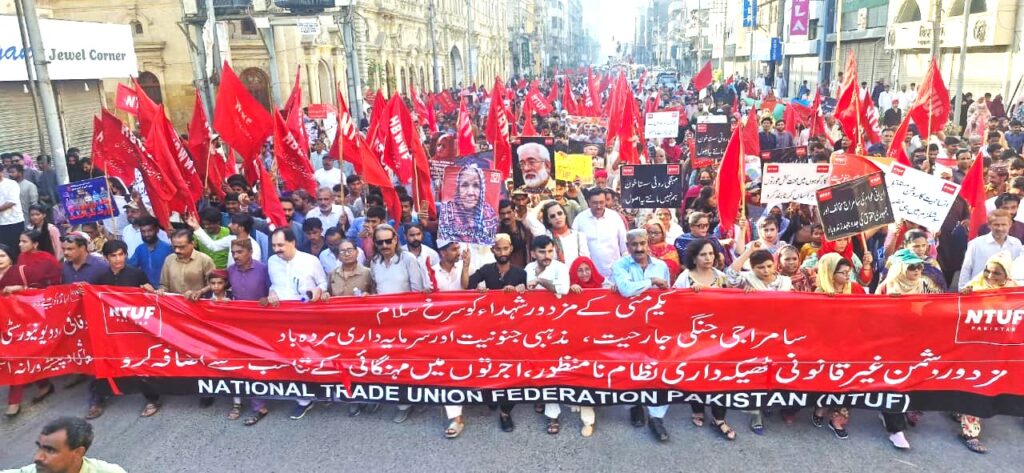
Trade unionists, political activists, workers and representatives of human rights organizations addressed the rally, jointly organized by the National Trade Union Federation Pakistan (NTUF) and the Home Based Women Workers Federation (HBWWF) along with allied organizations on International Workers’ Day.
The demonstration, held in memory of the May Day martyrs, was led by senior labor leader Comrade Gul Rehman and Industrial Global Union Textile and Garments Sector Co-Chairperson and HBWWF general secretary Comrade Zehra Khan. Thousands of workers from industrial units, journalists, teachers, lawyers, political activists and women workers participated.
Marching from Regal Chowk to the Karachi Press Club, participants carried red flags, banners and placards. They also displayed portraits of figures including Karl Marx, Lenin, Rosa Luxemburg, Che Guevara, Fidel Castro, Hugo Chávez, Shaheed Hassan Nasir, Shaheed Nazir Abbasi, Mai Bakhtawar and Comrade Hyder Bakhsh Jatoi, among others, described as symbols of resistance against exploitation.
Speakers said the Chicago workers’ struggle for shorter working hours and humane conditions had evolved into a global movement against imperialist wars, religious extremism, ecological destruction and capitalism itself.
Comrade Nasir Mansoor of NTUF said imperialist competition for energy and mineral resources had fueled wars, ethnic conflicts and religious divisions. He cited conflicts in Gaza, Lebanon, Syria, Sudan, Somalia, Yemen and Libya, along with economic blockades and sanctions against countries such as Cuba and Venezuela, describing them as evidence of what he called a violent global order. He added that millions had died while tens of millions had been displaced.
He noted that global military spending had reached 2.9 trillion dollars, while Pakistan had increased defence expenditure by 11 percent, arguing that even a fraction of such resources could address basic needs including health, education and housing.
Zehra Khan of HBWWF described climate change as a central labor issue, saying working-class communities were the most affected. She warned that tens of millions of jobs could be lost due to rising temperatures and climate stress, with heatwaves alone already causing severe physical strain and loss of working hours.
Labor representatives, including Liaquat Sahi of the Democratic Workers Union, said Pakistan had ratified multiple International Labor Organization conventions and adopted labor laws, yet the reality for workers remained bleak. They described widespread informalisation, lack of contracts, absence of social protection, and limited union rights.
Speakers also highlighted occupational safety failures, rising industrial accidents, wage theft, gender-based pay inequality and harassment at workplaces. HRCP’s Qazi Khizar said workplace conditions had reached “catastrophic” levels, with significant economic losses linked to injuries and unsafe environments.
Journalists’ representatives criticized restrictive laws such as the PECA Act and the outsourcing of media jobs, calling it a new form of precarity. Others pointed to corruption allegations in labor welfare institutions, including claims of large-scale misappropriation in the Sindh Workers Welfare Board and negligence at SESSI hospitals.
Victims of the Baldia factory fire tragedy also raised concerns about compensation processes, alleging lack of transparency and consultation in the handling of funds.
The rally adopted a wide-ranging set of demands, including the abolition of the contract labor system, living wages, enforcement of union rights, workplace safety, action against corruption, repeal of restrictive laws, and an end to privatization of public institutions. It also called for the release of political and labor activists, and for accountability over environmental damage and industrial policies.
