





By Pervaiz Mughal
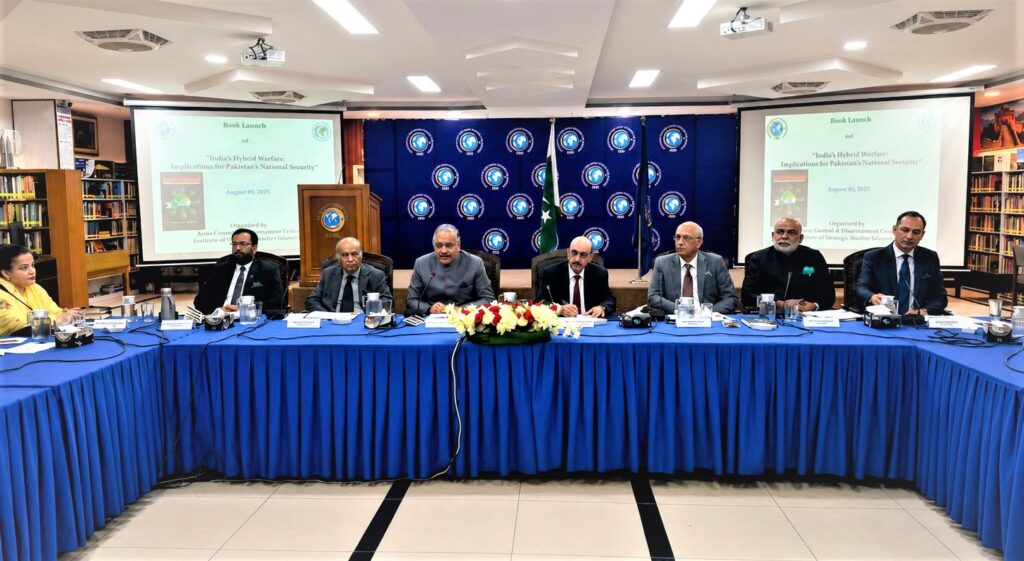
ISLAMABAD: The Arms Control and Disarmament Centre (ACDC) of the Institute of Strategic Studies Islamabad (ISSI) launched a book titled “India’s Hybrid Warfare: Implications for Pakistan’s National Security”, authored by Dr Muhammad Ali, at a ceremony attended by prominent defence and strategic affairs experts.
Former President of Azad Jammu and Kashmir Ambassador Sardar Masood Khan attended the event as chief guest, while retired General Zubair Mehmood Hayat delivered the keynote address. The ceremony was also attended by Maj Gen Dr Ehsan Mahmood Khan (retd), former Director General ISSRA; Prof Dr Tughral Yamin, Senior Research Associate at the Institute of Policy Studies Islamabad; and Dr Asma Shakir Khawaja, Executive Director of CISS AJK.
Speaking on the occasion, Ambassador Sardar Masood Khan said the book provided a valuable academic examination of the theoretical framework of hybrid warfare. He observed that hybrid warfare was not a new phenomenon, as similar approaches had existed in earlier periods of history.
He stressed that national integration remained a vital element of statecraft and said Pakistan needed to address both external and internal challenges while remaining prepared to counter emerging hybrid threats.
In his keynote address, Gen Zubair Mehmood Hayat (retd) praised Dr Muhammad Ali for publishing the book at an important time. He said a major shift in India’s policy outlook towards Pakistan had been influenced by the Doval Doctrine, under which civil society had become a new frontier and offensive and defensive measures were advocated against Pakistan.
He said hybrid warfare was no longer only a theoretical concept but had evolved into a practical and changing method of conflict. He added that no society could maintain strength or survive if it lost hope and faith in itself, as weakening public confidence in national identity could undermine a country without direct conventional warfare.
In his welcome remarks, ISSI Director General Ambassador Moin ul Haque described the book as an important contribution towards understanding evolving security challenges. He said modern warfare had become increasingly complex and multidimensional, with hybrid warfare seeking strategic objectives without crossing the threshold of declared conflict.
He also appreciated the author for presenting actionable recommendations aimed at strengthening Pakistan’s response to threats affecting its national security.
Malik Qasim Mustafa, in his introductory remarks, praised Dr Ali’s evidence-based analysis of India’s hybrid warfare against Pakistan. He emphasized the need for a comprehensive whole-of-nation approach based on stronger coordination, national cohesion, effective governance and media resilience.
Maj Gen Dr Ehsan Mahmood Khan (retd) said while the conventional battlefield remained relevant, it was now accompanied by other domains of conflict, including cyber, economic and psychological warfare.
Prof Dr Tughral Yamin stressed the need for Pakistan to develop a comprehensive national response to hybrid warfare, while Dr Asma Shakir Khawaja highlighted the importance of knowledge in empowering societies and countering cognitive biases and disinformation. She described the research as a timely contribution to understanding the subject.
Ambassador Khalid Mahmood, in his vote of thanks, said India had used diplomatic pressure, disinformation and narrative manipulation to undermine Pakistan’s international standing. He added that Pakistan’s expanding diplomatic role and institutional resilience had helped it withstand such pressures and strengthen its global position.
Dr Muhammad Ali is an alumnus of the National Defence University Islamabad, where he studied public policy and strategic security. He later joined Islamia University Bahawalpur, from where he completed his PhD in 2024. He has also gained diverse academic experience through engagements with educational institutions in the United Kingdom, China and Saudi Arabia, contributing to his understanding of global defence and security affairs.
ISSI #InstituteOfStrategicStudiesIslamabad #HybridWarfare #IndiasHybridWarfare #PakistanNationalSecurity #IndiaPakistan #NationalSecurity #StrategicStudies #DefenceStudies #HybridThreats #SecurityChallenges #PakistanDefence #Disinformation #CyberWarfare #PsychologicalWarfare #EconomicWarfare #NationalCohesion #MediaResilience #StrategicAffairs #DefenceExperts #PakistanSecurity #ForeignPolicy #DovalDoctrine #Islamabad #PakistanPolitics
