





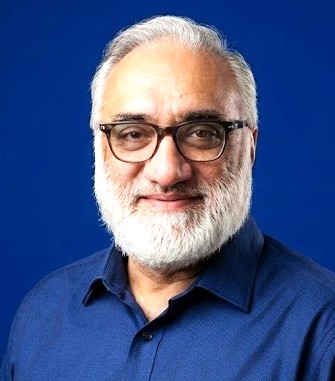
By Dr. Zafar Iqbal
There is a moment in every escalating crisis when the accumulation of events ceases to be a chain of cause and effect and instead becomes a single, ungovernable mass. We have, I suspect, just passed that moment in the Middle East. For weeks, the discourse has been dominated by the familiar lexicon of retaliation: strikes, counter-strikes, red lines, and the inevitable, almost ritualistic, warnings. But beneath the surface of these military exchanges, a more profound and arguably more dangerous shift has occurred. It is a shift that moves the theatre of conflict away from the bombed-out ruins of military installations and into the far more destabilizing arenas of global energy, food security, and economic leverage.
The conventional wisdom, often shaped by the rapid churn of a twenty-four-hour news cycle, has been to view this moment through the familiar prism of direct military confrontation between Israel and Iran. Yet a more nuanced, and chilling, analysis suggests that the opening weeks of this latest escalation have not weakened the Islamic Republic in the ways its adversaries might have hoped. On the contrary, as scholars like Robert A. Pape of the University of Chicago have noted, a nation can emerge from the first shock of war not diminished, but reconstituted in a more dangerous form. The evidence for this lies not in missile stockpiles, but in the quiet, almost unnoticed, consolidation of economic power.
Consider the facts that lie outside the headlines of airstrikes. With the effective loosening of oil sanctions, a corridor has opened through which Iran and Russia have transacted approximately $1.5 billion worth of oil via Chinese financial institutions. This is not merely a commercial transaction; it is the construction of a parallel financial architecture, one that exists beyond the reach of traditional Western leverage. Simultaneously, Iran has solidified its control over a staggering thirty per cent of the world’s fertiliser production. This is not a sideshow to the main event; it is the main event. It represents the weaponisation of two of the most essential components of modern life: fuel and food.
The fog of this moment is made thicker by the peculiar language emanating from world capitals. We hear a lexicon of deterrence, yet witness actions that suggest a dangerous improvisation. One day, there is talk of postponing strikes on energy facilities; the very next night, those facilities are targeted. We are deep in what military strategists term a VUCA environment—volatile, uncertain, complex, and ambiguous—where the line between a strategic off-ramp and a blind alley becomes impossible to discern. The recent targeting of nuclear-related sites in Natanz and Dimona signals a crossing of thresholds that were once considered sacrosanct. This is no longer a simple game of tit-for-tat. It is a high-stakes contest of escalation dominance, where the very definition of victory has become murky.
This anecdote, poignant in its simplicity, captures the predicament now facing the United States and its allies. The blanket in the water is this conflict: a tangle of economic leverage, nuclear brinkmanship, and proxy warfare that has taken hold of the region. The young man in the water is a superpower that finds it can no longer simply walk away. The decision to deploy ground forces, if it comes, will not be a strategic choice in the traditional sense; it will be an admission that the blanket will not be released. It will be the point at which temporary disruption becomes permanent, costly entanglement.
In the coming days, the world will be watching two things with bated breath. The first is the decision on a ground incursion into Lebanon or beyond—the clearest signal yet of whether this crisis can still be contained or is destined to spiral into a regional conflagration. The second is Iran’s next move. Having demonstrated its capacity to weaponise economic interdependence, will it wield that power with restraint, or will it deploy it as a prelude to a wider war? The answers to these questions will determine whether we are simply witnessing another chapter in the long, sad history of Middle Eastern conflict, or the opening of a new and terrifying chapter in global instability.
What is becoming clear is that the traditional off-ramps—diplomatic concessions, mediated ceasefires, unilateral de-escalation—are no longer clearly visible. The landscape has changed. We are no longer just negotiating over nuclear centrifuges and buffer zones; we are negotiating over the price of bread in Cairo, the cost of fuel in London, and the stability of the global order. The blanket has wrapped itself around the swimmer. The question now is whether the swimmer has the strength to swim to shore with it, or whether both will be swept away by the current.
(The writer is involved in training and practical services in healthcare management, quality, and patient safety. His interests include current affairs, IR, environmental issues, Iqbal studies, political, literary, and national affairs, can be reached at editorial@metro-morning.com)
