





By Aziz Khatri
KARACHI: The Arts Council of Pakistan Karachi hosted an extended scholarly lecture by renowned religious scholar, researcher and literary figure Ayatullah Allama Syed Aqeel-ul-Gharavi on the theme “The Genre of Salam in Urdu Poetry: A Study in Creative Tradition and Critical Insight.”
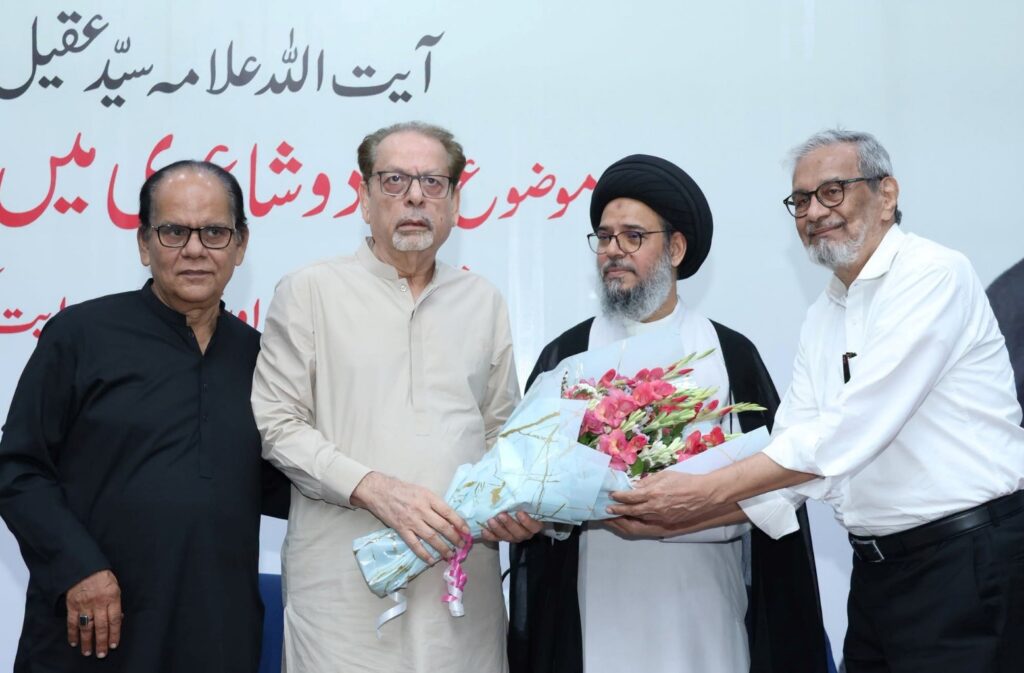
The event, held at Haseena Moin Hall, was attended by a large number of writers, poets, researchers, academics, students and literature enthusiasts. The proceedings were conducted by Syed Javed Hassan, while Arts Council President Mohammad Ahmed Shah welcomed the distinguished speaker.
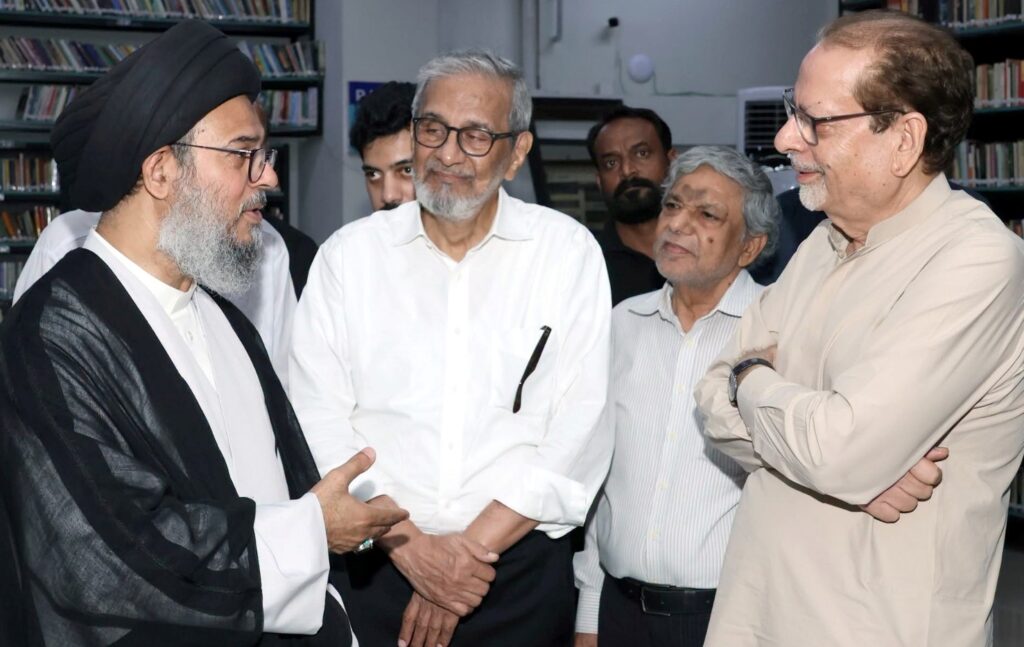
Addressing the gathering, Ayatullah Allama Syed Aqeel-ul-Gharavi said the literary tradition of Salam in Urdu poetry was rich and extensive, with a significant body of work already published while many important works still required academic research and documentation.
Explaining the historical development of Urdu poetry, the scholar said many poetic forms were influenced by Persian and Arabic literary traditions. He added that the ghazal itself travelled from Arabic to Persian literature before becoming an important part of Urdu poetry.
Discussing the meaning of Qasida, Ayatullah Gharavi said the Arabic term had a broader meaning than its commonly understood interpretation in Urdu and was associated with several poetic forms, including manqabat, marsiya, nauha and, in some contexts, ghazal.
He emphasised that Salam was not derived from ghazal nor was it a subgenre of the form. Instead, classical poetic genres such as Qasida, Hamd, Naat, Salam, Marsiya and Manqabat share similar poetic structures while differing in themes and expression.
Drawing a distinction between ghazal and Salam, he said ghazal mainly reflected human emotions, worldly experiences and romantic themes, whereas Salam represented spirituality, reverence, purity and divine love.
Speaking about Marsiya and Salam, Ayatullah Gharavi said that while expressing grief for the Ahl al-Bayt (AS) remained an important element of the tradition, literature should also highlight the patience, courage, dignity and moral strength of Imam Hussain (AS).
He said Imam Hussain (AS) should not only be remembered through the lens of tragedy but also recognised for his determination, resilience and exemplary character. He added that mourning reflected the emotions of believers, while literature should preserve and present the greatness and values associated with Imam Hussain (AS).
