





By our correspondent
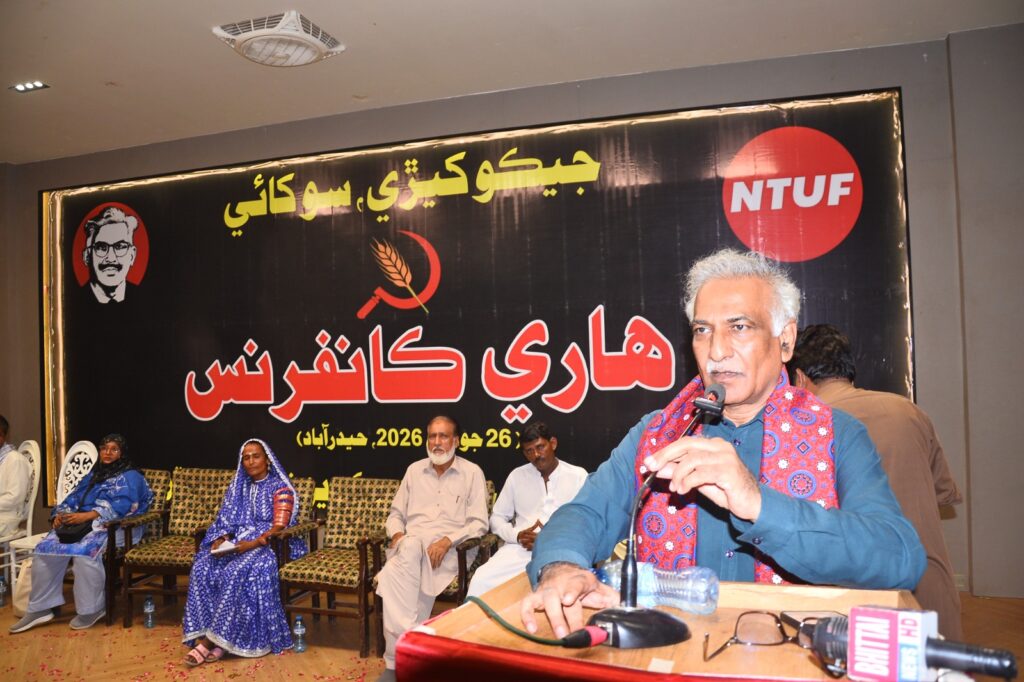
HYDERABAD: A large Hari Conference held in Hyderabad brought together peasant representatives, tenant farmers and women agricultural workers from across Sindh, where speakers warned that the province’s farming communities were facing a deepening economic and environmental crisis.
Organized by the Sindh Agricultural General Workers Union, affiliated with the National Trade Union Federation Pakistan (NTUF), the gathering said rising production costs, falling crop prices and worsening water shortages had pushed many small farmers into severe hardship. Delegates argued that despite producing much of the country’s food, agricultural workers had remained trapped in poverty with little access to state support.
Speakers said government relief measures had largely failed to reach genuine Haris because many agricultural workers were still not formally recognized or registered. They expressed concern over the unequal distribution of Indus River water, the construction of new canals and the growing impact of climate change, which they said had damaged crops, livestock and rural livelihoods.
The conference urged the federal and Sindh governments to introduce stronger climate adaptation measures, disaster relief and compensation programs for small farmers and women agricultural workers. Participants also highlighted widespread insecurity among rural communities.
They said forced evictions, violence, intimidation and land disputes continued to threaten peasants, while many farming families struggled to educate their children or escape generational poverty. Speakers argued that meaningful agrarian reforms remained essential to ensure fair land distribution, secure tenancy rights and protection from exploitation.
The conference criticized the continued failure to fully implement the Sindh Industrial Relations Act (SIRA) 2013, saying agricultural workers had remained deprived of legal protections and labor welfare benefits more than a decade after the law was enacted.
Delegates demanded immediate registration of agricultural workers with Social Security and the Employees’ Old-Age Benefits Institution (EOBI), alongside access to welfare schemes, justice through dedicated Hari Courts, protection of Sindh’s water rights and stronger legal action against forced labor, violence and the exploitation of women agricultural workers.
The participants pledged to strengthen the peasant movement and continue campaigning for land rights, social protection, climate justice and the full enforcement of SIRA 2013.
