





By our correspondent
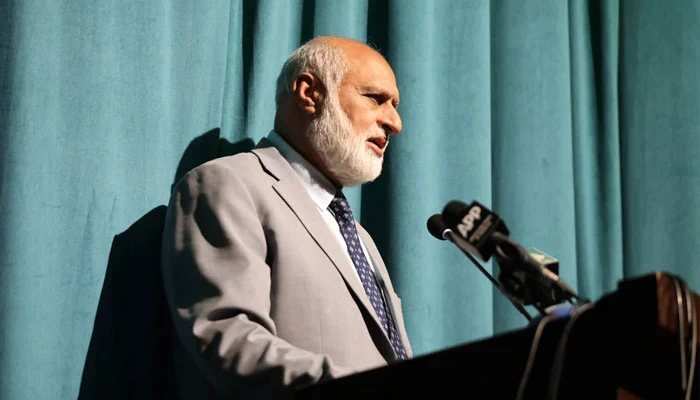
ISLAMABAD: Pakistan must place universities, research and human capital at the centre of its national development strategy if it is to move from a developing to a developed country, the Higher Education Commission chairman, Dr Niaz Ahmad Akhtar, has said.
Speaking about his nearly two-week visit to China, Akhtar said the country’s remarkable economic, scientific and technological progress was closely linked to strong ties between universities, industry and government.
He said Chinese universities were not simply institutions that awarded degrees but had become engines of national development. Pakistan, he added, needed to similarly connect higher education with economic growth, technology and the development of skilled human capital.
Akhtar visited China at the direction of the prime minister and following invitations from China’s Ministry of Education, universities and other institutions. He travelled with a delegation of senior vice-chancellors from leading Pakistani universities.
During the visit, discussions focused on double, joint and dual-degree programmes, faculty and student exchanges, collaborative research, expanded opportunities for Pakistani students to study in China and making the CPEC Consortium of Universities more active.
At Beijing Language and Culture University, Akhtar met university leaders and senior academics. He also held discussions with the leadership of the World Sinology Centre on establishing 10 Sinology centres in Pakistan. The HEC has been asked to nominate 10 Pakistani universities for the initiative.
Meetings with the China Association of Higher Education and Chinese university leaders also explored ways to move Pakistan-China academic cooperation beyond formal agreements towards practical and lasting partnerships. Pakistani vice-chancellors took part in several of the discussions.
Akhtar said visits to institutions including Fudan University and North China Electric Power University, as well as engineering and technology universities and research centres in Shanghai, demonstrated how closely Chinese universities were linked to economic and industrial development.
He said research in China was not treated simply as a means of publishing academic papers. Universities were expected to turn research into technologies, products, businesses and solutions to industrial problems.
The HEC chairman said China had made substantial investments in research and development. During a visit to a major R&D institution, he was told that around 20% of its income was reinvested in research and development, with its annual R&D budget running into billions of dollars.
Artificial intelligence, digital technology, robotics and automation were also being used extensively beyond laboratories, he said, including in hotels, factories, transport systems and cities.
Akhtar said China’s rapid development of electric vehicles was particularly significant, showing how quickly established technologies could be transformed. The future, he said, would belong to countries capable of creating technology rather than simply consuming it.
He said Pakistan should study China’s experience without attempting to copy its system wholesale. Universities needed to ask whether they were merely producing degree holders or creating the human capital and technology required to transform the economy.
Curricula should be aligned with future needs, he said, while artificial intelligence, data science, automation and other emerging technologies should become an integral part of teaching. Faculty development and stronger links between universities and industry were also essential.
Graduates, he added, needed to become workplace-ready rather than simply holding academic qualifications. Research should likewise move beyond journal publication and contribute to solving national problems, improving industrial production, developing new technologies and creating business opportunities.
After returning from China, Akhtar said he had shared his observations with vice-chancellors in Sindh, Balochistan and Punjab, followed by university leaders from Azad Jammu and Kashmir, Gilgit-Baltistan and the federal capital.
The most important lesson from the visit, he said, was that a nation’s real strength lay not only in roads, buildings and factories but in knowledge and human capital.
“Pakistan has a young population, talented teachers and researchers and a wide network of universities,” he said, but the country needed a clear national direction and a genuine commitment to education and research.
Akhtar said China’s experience showed that when national vision, higher education, research, technology, industry, investment and hard work moved in the same direction, countries could transform their future. For Pakistan, he said, the road to national prosperity must begin in university classrooms and research laboratories before reaching industry and the wider economy.
#Pakistan #HigherEducation #HEC #Research #China #Education
