





News Desk
LONDON: Scientists at the University of Delaware are studying whether sharks could help improve forecasts of hurricane intensity by serving as mobile ocean-observing systems.
Researchers are fitting sharks with sensors that measure ocean temperature, electrical conductivity and depth. Conductivity provides an indication of the amount of salt in seawater, giving scientists a broader picture of conditions beneath the surface.
Aaron Carlisle, a professor at the university’s School of Marine Science and Policy and the study’s lead researcher, said animal-borne sensors had already been used successfully in marine research, particularly in areas where conventional scientific observations were limited.
Sharks could be particularly useful because they are widespread, travel across large areas of the ocean and are generally easier to access than some protected marine mammals, researchers said.
Shark tags have traditionally been used to track movements and habitats. The new research, however, is focused on identifying species that can collect data useful for hurricane forecasting and regularly approach the surface, allowing their tags to transmit information through satellite networks.
Early analysis in the North Atlantic has identified shortfin mako, blue, smooth hammerhead and juvenile great white sharks as potentially suitable for the research.
Scientists are particularly interested in heat stored in the upper ocean, known as the mixed layer. According to Carlisle, this layer can play an important role in hurricane intensity because warmer water in the mixed layer can provide more energy for stronger storms.
The shark-tagging work begins in early May, when several migratory species return closer to the coast after spending winter in more distant parts of the Atlantic, according to doctoral researcher Caroline Wiernicki.
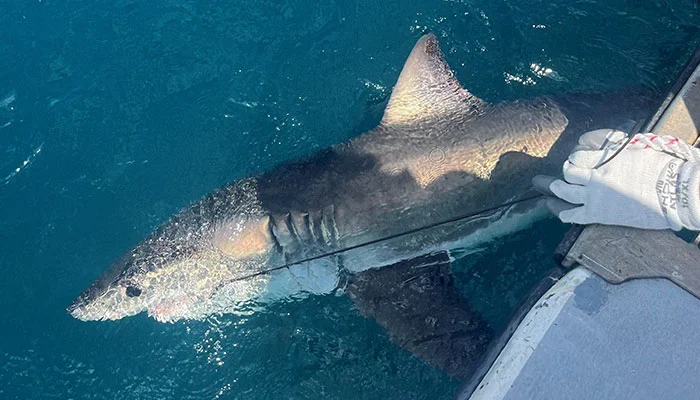
Researchers travel by boat to waters about 50 to 65km offshore, deploy baited lines and typically wait two to three hours for a shark to approach. Once captured, a sensor is attached to the shark’s dorsal fin.
When the shark comes close to the surface, the tag connects with a network of satellite receivers and transmits the collected data.
Carlisle said the tagging procedure was completed quickly, much like a pit crew during a motor race, and normally took less than five minutes. The process is carried out under institutional animal-care oversight to minimise the impact on the sharks.
The tags are attached using materials designed to break down over time and detach naturally. Each shark is also examined before being released, as stress or injury could alter its natural behaviour and potentially affect the quality of the data collected. Wiernicki said sharks were often portrayed as frightening animals in films, whereas in reality they were relatively calm.
If the project succeeds, researchers hope shark-derived data could improve forecasts of hurricane intensity along the US east coast. More reliable forecasts could help communities from North Carolina to Massachusetts prepare for storms and strengthen coastal protection.
Carlisle said sharks were remarkably well adapted to life in the ocean and could teach scientists much about marine conditions. If they can also provide information that benefits people, he said, it could prove advantageous for both sharks and humans.
#Sharks #Hurricanes #HurricaneForecast #ClimateScience #OceanScience #MarineScience #UniversityOfDelaware #ClimateResearch #WeatherForecast #OceanResearch #ScienceNews #Technology #Environment #USA #BreakingNews #LatestNews #TrendingNews
