





Amid rising Middle East tensions, Pakistan and China voiced shared concern and pledged deeper collaboration under the ambitious CPEC-II framework
MM Report
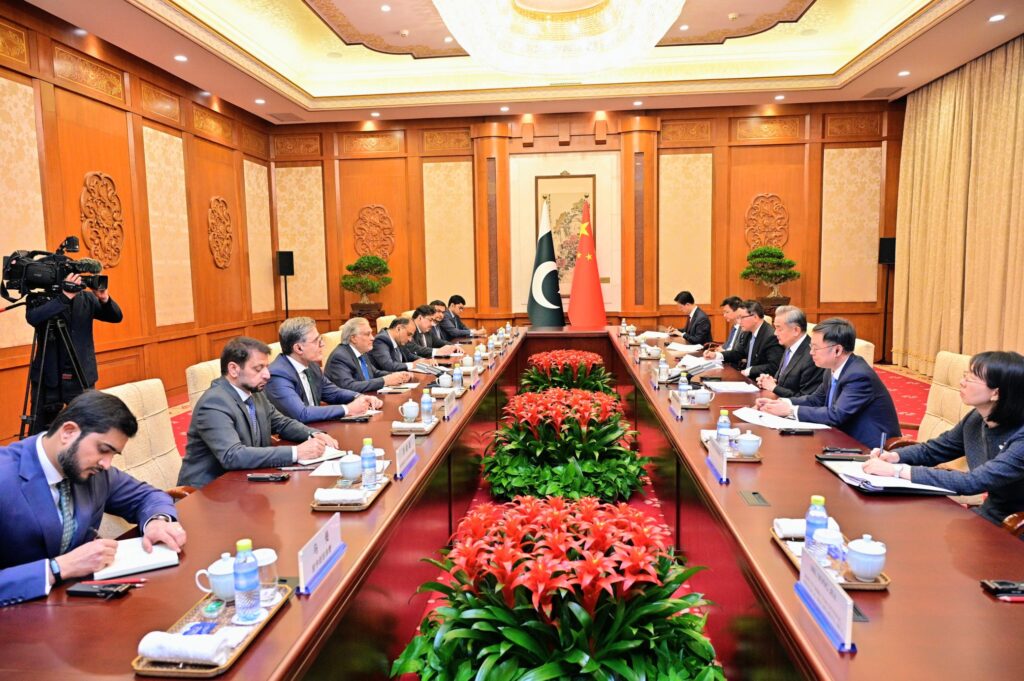
BEIJING: During an official visit to China, Deputy Prime Minister and Foreign Minister of Pakistan, Ishaq Dar, and his Chinese counterpart Wang Yi held extensive talks that culminated in the launch of a joint five-point initiative aimed at restoring peace and stability in the Middle East.
The visit, described by Pakistan’s Foreign Office as marked by traditional warmth and goodwill, highlighted both countries’ desire to address regional crises while reinforcing their bilateral partnership. According to official statements, the five-point plan focuses on key measures such as securing ceasefires, promoting dialogue, strengthening security, and ensuring adherence to the principles of the United Nations Charter.
Both sides stressed that ongoing conflicts in the Gulf and broader Middle East were having serious socio-economic repercussions, particularly for developing countries, and underscored the importance of coordinated diplomatic efforts to mitigate the crisis. Chinese officials noted that the recent month-long escalation around Iran had created ripple effects across the region, threatening not only stability but also the broader interests of the international community.
During the discussions, Dar briefed Chinese leaders on Pakistan’s active diplomatic engagement, including a recent meeting of foreign ministers from Pakistan, Saudi Arabia, Turkey, and Egypt aimed at restoring dialogue and reducing tensions. Chinese officials expressed full support for Pakistan’s initiatives, praising its role in facilitating peace efforts.
Both sides also reaffirmed the growing strength of Pakistan-China relations, highlighting ongoing collaboration under the China-Pakistan Economic Corridor, strategic coordination, high-level exchanges, and development cooperation as central to their long-term partnership. The two foreign ministers further discussed Afghanistan, stressing the need for regional stability, peace, and effective counter-terrorism measures.
Officials agreed to maintain regular communication to coordinate responses to regional and global developments. The Chinese Foreign Office noted the shared positions of Pakistan and China within the Global South and highlighted their efforts to build consensus in international forums.
At the conclusion of the visit, Ishaq Dar expressed gratitude for the hospitality extended by Chinese leadership, describing the trip as a reaffirmation of mutual trust and a shared commitment to promoting peace, stability, and sustainable development both regionally and internationally.
