





By MM Report
SAINT PETERSBURG: Autonomous AI agents were no longer simply tools; they were becoming independent participants in the economy, managing assets, executing transactions and building value chains. The global market for agent-based AI was already projected to exceed USD 9 billion in 2026 and was forecast to grow to USD 139 billion by 2034.

This was not merely the evolution of automation; it represented a structural shift and a fundamental change in the very logic of value creation, the role of intermediaries and the principles of market governance. Agent-based economics offered speed, personalisation and resilience, yet simultaneously raised questions for which there were currently no answers.
Who was responsible for a decision made by an algorithm? Where did the boundary of an agent’s autonomy lie, particularly when money and critical infrastructure were at stake? How could transparency be ensured in a system where transactions were executed in milliseconds without human intervention?
Autonomous AI agents were no longer simply tools; they were becoming independent participants in the economy, managing assets, executing transactions and building value chains. The global market for agent-based AI was already projected to exceed USD 9 billion in 2026 and was forecast to grow to USD 139 billion by 2034.
This was not merely the evolution of automation; it represented a structural shift and a fundamental change in the very logic of value creation, the role of intermediaries and the principles of market governance. Agent-based economics offered speed, personalisation and resilience, yet simultaneously raised questions for which there were currently no answers. Who was responsible for a decision made by an algorithm? Where did the boundary of an agent’s autonomy lie, particularly when money and critical infrastructure were at stake? How could transparency be ensured in a system where transactions were executed in milliseconds without human intervention?
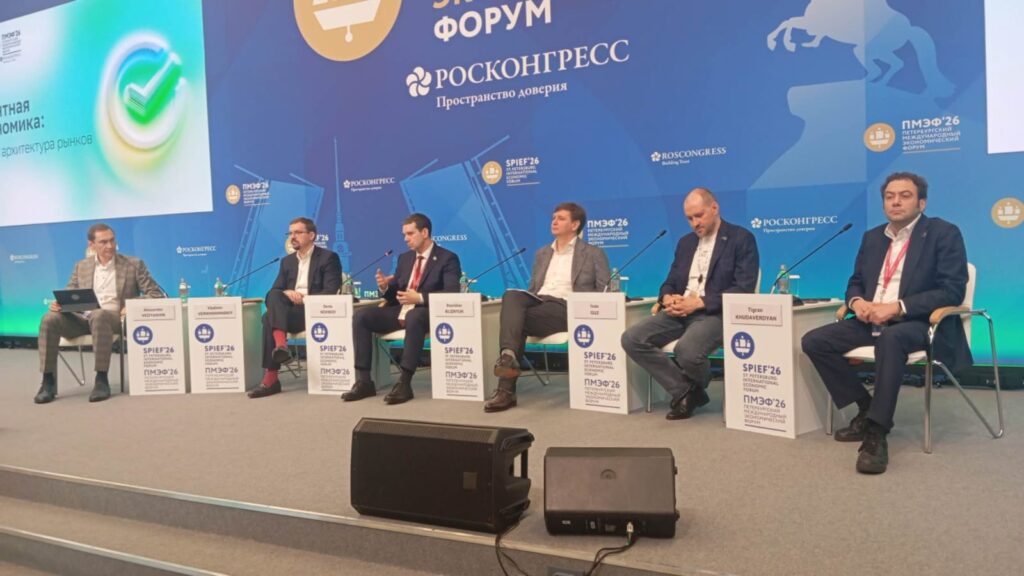
The discussion was moderated by Alexander Vedyakhin, First Deputy Chairman of the Executive Board at Sberbank.
Participants included Stanislav Bliznyuk, Head of Laboratory of Neural Networks and Deep Learning at MIPT; Vladimir Verkhoshinskiy, Chief Executive Officer of Ingosstrakh; Ivan Guz, Managing Director for ESG at Sberbank; Denis Novikov, Director of the Department of Strategic Development at the Ministry of Economic Development of Russia; and Tigran Khudaverdyan, Vice President of the Platform for Urban Initiatives at Sberbank, who examined the growing role of autonomous AI agents as economic actors and the implications of their expanding influence on markets, governance and accountability.
