





By Special Correspondent
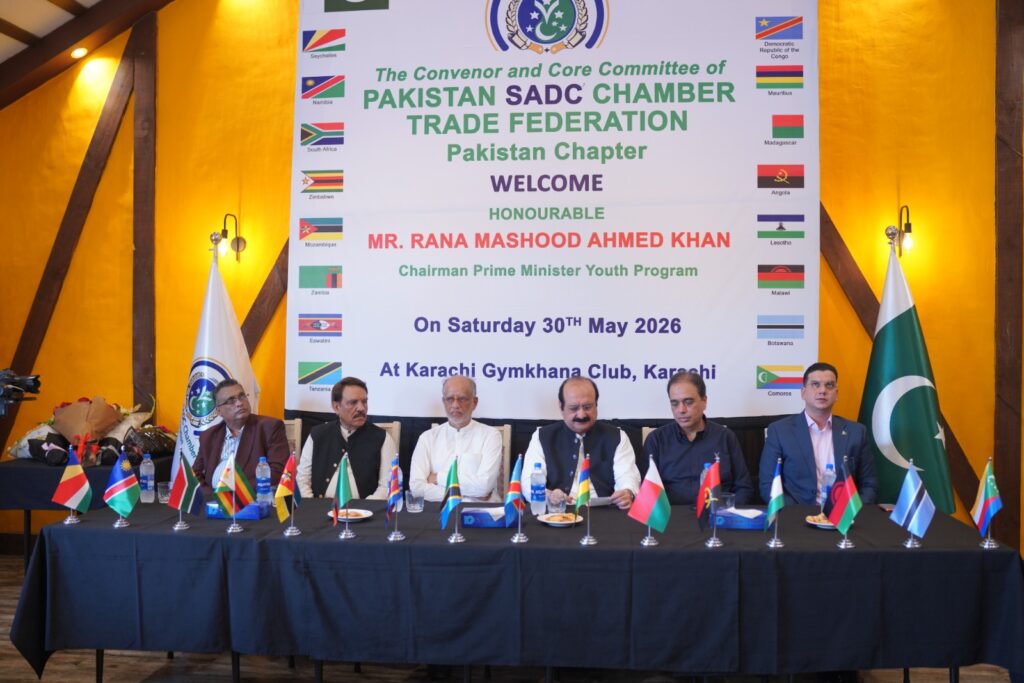
KARACHI: The Chairman of the Prime Minister’s Youth Programme, Rana Mashood Ahmed Khan, said Pakistan had played a significant role in preventing a potential Third World War and that the recent successful Islamabad talks would contribute to peace and stability in the region.
Rana Mashood was speaking as the chief guest at a business breakfast organised by the Pakistan-SADC Chamber at Karachi Gymkhana on Saturday. He said that approximately 30 per cent of the China-Pakistan Economic Corridor (CPEC) had been completed, while the remaining work was expected to be finished within the next three years. He noted that the coming year would remain challenging due to tensions surrounding the Strait of Hormuz.
Highlighting Pakistan’s strategic geographical importance, PMYP’s head referred to the growing significance of Karachi and Gwadar ports, stating that transhipment activities had generated profits equivalent to two years’ earnings within just two months. Addressing members of the business community, he said Pakistan had successfully avoided a sovereign default in 2022.
Rana warned that a default could have led to severe social and political instability similar to situations witnessed in Syria, Iraq and Libya, while also endangering Pakistan’s nuclear deterrence. He informed participants that Service Tyres was collaborating with Chinese industries and that substantial Chinese investments were expected in Pakistan.
Rana Mashood emphasised the government’s focus on empowering youth through digital opportunities. He said Karachi’s economic potential must be fully explored and that the city deserved greater benefits under the National Finance Commission (NFC) Award.
He also highlighted scholarship programmes under the Punjab Education Endowment Fund for students admitted to top universities. He announced the launch of the “Perfect Pitch” initiative, under which 100 innovative ideas from young entrepreneurs would be selected annually and financed with support from the business community.
He further mentioned the Digital Youth Portal, where young people could register to access opportunities, along with agricultural loans being disbursed at low markup rates. Citing the example of a successful startup manufacturing MotoVest jackets, he said the venture was earning millions of dollars in international markets.
Responding to media questions, Rana Mashood identified poor governance as the root cause of many of Karachi’s challenges. Earlier, Senior Vice President of the Pakistan-SADC Chamber, Syed Moiz Uddin, said Africa possessed immense untapped economic potential. He stressed the importance of strengthening direct business linkages within the 16-member Southern African Development Community (SADC) region across sectors including textiles, pharmaceuticals, engineering, information technology, healthcare and fast-moving consumer goods (FMCG).
Chief Executive Officer of Imtiaz Enterprises and Chairman of the Pakistan-American Business Forum, Imtiaz Hussain, emphasised agricultural growth and called for greater recognition of Pakistan’s contribution to global sports, noting that footballs manufactured in Pakistan were used in FIFA World Cup tournaments.
He expressed concern over declining exports and the widening trade imbalance, stressing the need for agreements to promote trade and economic cooperation. He also highlighted the popularity of Pakistani spices across Asian communities worldwide.
Patron-in-Chief of the Pakistan-SADC Chamber, Rafiq Suleman, urged the government to provide stronger institutional support for developing trade and banking channels with African countries.
Chairman of the Association of Builders and Developers (ABAD), Hassan Bakhshi, said the construction sector was a key indicator of urban development. He called on the Prime Minister to engage directly with stakeholders and create a business-friendly environment capable of attracting investment back to Pakistan. He also urged diplomatic efforts to safeguard Pakistani investments in the UAE.
Senior Vice President of the Federation of Pakistan Chambers of Commerce and Industry (FPCCI), Saquib Fayyaz Magoon, stressed the urgent need to reform university curricula to meet modern economic requirements. He emphasised the importance of startup mentorship and import substitution policies, while expressing concern over Pakistan’s $21 billion trade deficit and the challenges facing the country’s ambitious export targets.
Speakers at the forum collectively called for an export-led growth strategy, greater industrialisation, enhanced investment opportunities and stronger government efforts to expand Pakistan’s trade footprint in Africa. They said unlocking African markets could provide substantial opportunities for Pakistani exporters and investors.
The event concluded with a unanimous call for a growth-oriented, investment-friendly, export-driven and people-centric federal budget that addressed the concerns of businesses, industry and ordinary citizens.
