





By Zahid Karani
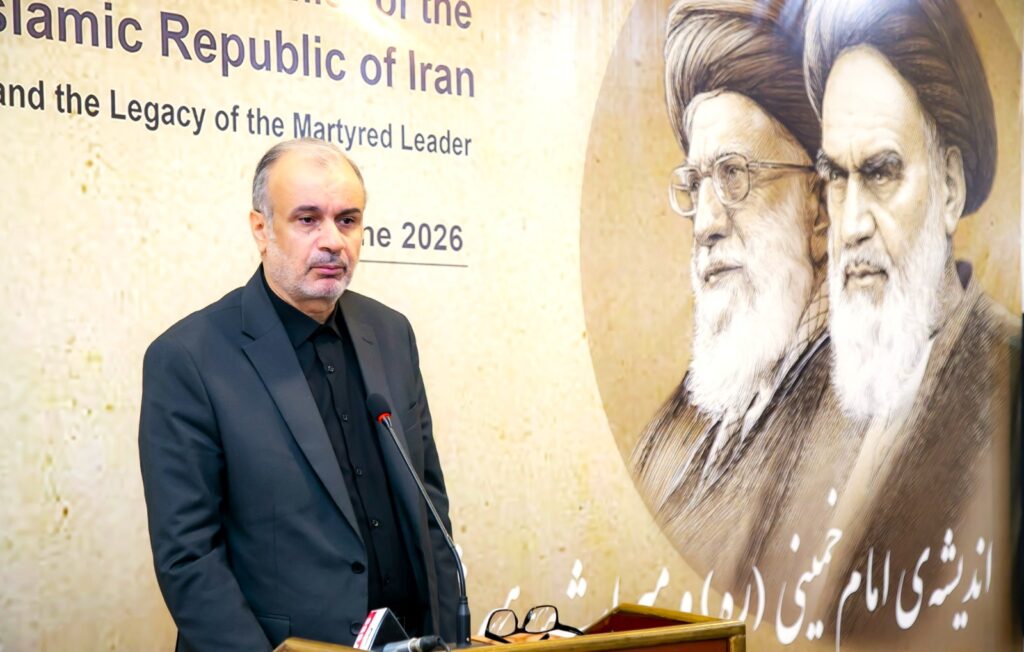
KARACHI: A solemn ceremony was held at the Consulate General of the Islamic Republic of Iran in Karachi to mark the 37th death anniversary of the founder of the Islamic Revolution, Ruhollah Khomeini, alongside tributes to Iran’s Supreme Leader Ali Khamenei and those described as martyrs of recent conflicts.
The event brought together a diverse gathering of religious scholars from both Shia and Sunni schools of thought, lawyers, academics, journalists, and representatives of various political and religious organisations. Iranian Consul General in Karachi Akbar Isazadeh welcomed the guests and said that Imam Khomeini’s movement was rooted in Quranic teachings, the life of the Prophet Muhammad, and the concept of Wilayat-e-Ali. He said the principles of independence, sovereignty, and protection of national interests formed the foundation of the Islamic Revolution.
He further stated that in the post-revolutionary phase, Ayatollah Ali Khamenei had played a key role in safeguarding the ideological and political continuity of the revolution amid what he described as global political, security, cultural, and economic challenges. He credited Iran’s resilience and development to policies based on resistance, national strength, and self-reliance.
Speakers at the event described national unity in Iran as a reflection of the ideological legacy of Imam Khomeini and praised what they called the cohesion of the Iranian state in the face of external pressure. They also referenced recent tensions involving Iran and regional adversaries, portraying internal unity as a central factor in sustaining the country’s political stability.
Chairman of the Pakistan National Unity Council Sahibzada Abu al-Khair Zubair said that support for Iran and opposition to its adversaries represented broader Muslim unity inspired by Imam Khomeini’s vision. He argued that external attempts to weaken Iranian cohesion had failed due to what he described as strong national solidarity.
Sindh Supreme Court Bar Association Chairman Haseeb Jamali said Iran’s recent political posture reflected “insight and unity” under the guidance of Ayatollah Khamenei, adding that efforts to create divisions within Iranian society had not succeeded. He also highlighted Iran’s emphasis on self-reliance and institutional development.
Prominent Shia scholar Allama Syed Razi Jafer Naqvi described Imam Khomeini’s legacy as one of resistance and steadfastness, saying Iran’s global image had transformed due to its long-standing ideological posture. He also referenced religious rulings aimed at promoting unity among Muslim sects.
Other speakers, including Member of National Assembly Syed Hafeez-ud-Din, Karachi Council for Foreign Relations representative Lady Nighat Panjwani, and former Jamaat-e-Islami Karachi chief Meraj-ul-Huda Siddiqui, also addressed the gathering and paid tribute to the ideological foundations of the Iranian revolution and its continued influence under its current leadership.
