





Aurangzeb says Pakistan has made comprehensive efforts to create an enabling environment for export-led growth under renewed economic policy direction
By Pervaiz Mughal
ISAMABAD: Finance Minister Muhammad Aurangzeb said on Saturday that Pakistan’s economy was firmly moving from stabilisation towards growth, as he elaborated on the federal budget proposed on Friday for the upcoming fiscal year 2026-27.
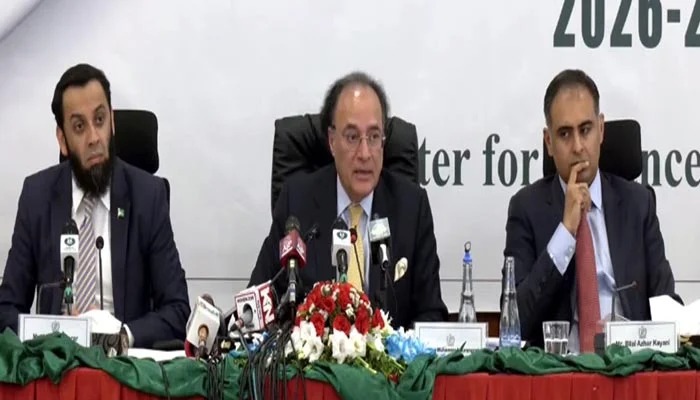
“The economy is moving in the right direction […] we will now move from economic stability to growth,” Aurangzeb said while addressing a post-budget press conference, flanked by Minister of State for Finance and Revenue Bilal Azhar Kayani, Information Minister Attaullah Tarar, and Federal Board of Revenue Chairman Rashid Mahmood Langrial.
The finance minister said the government had worked to strengthen both the tax and export frameworks in the budget, adding that significant economic progress had been achieved during the outgoing fiscal year. He said the available fiscal space had been utilised in the best possible manner.
“The main theme of this budget is export-led growth. A key question has been what constitutes an enabling environment for exports, and in this budget we have made comprehensive efforts to address those factors,” he added.
Aurangzeb announced that Rs70 billion in additional subsidies had been allocated to allow exporters access to financing at a reduced rate of 4.5%, a measure aimed at boosting export competitiveness and improving sectoral liquidity. He confirmed that the super tax had been abolished for businesses earning more than Rs500 million, describing it as a significant step.
He added that when the budget was presented before Prime Minister Shehbaz Sharif and the federal cabinet, a specific directive was issued to abolish the super tax for all exporters — a measure he said he would include in his concluding speech at the end of the budget session. The advance tax has also been abolished as part of efforts to create an enabling environment for export-led growth, he said.
He said these taxation measures were not isolated decisions but part of a broader policy direction aimed at incentivising production, encouraging documentation, and supporting industries that contribute to exports. “This is about setting the right direction of travel — moving towards a tax system that supports growth rather than constrains it,” he remarked.
