





By Aslam Shah
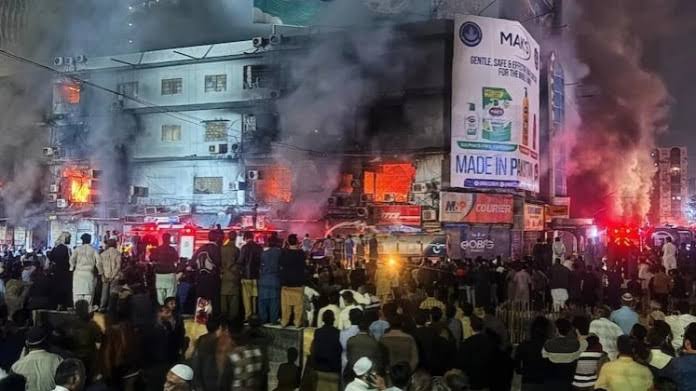
KARACHI: The official inquiry into Karachi’s devastating Gul Plaza fire, which claimed 86 lives, has come under renewed scrutiny amid allegations that government institutions and senior officials were shielded from accountability, prompting criticism from civil society groups, opposition parties and legal observers.
The inquiry report placed primary responsibility for the tragedy on the market management committee and several shopkeepers. It cited the absence of emergency facilities, inadequate firefighting equipment, locked internal exits and blocked escape routes. Critics, however, argued that such shortcomings could not be separated from the responsibilities of public regulatory bodies tasked with enforcing building safety laws.
Although the report recommended disciplinary proceedings against a limited number of officials from the fire service, Civil Defence, the district administration, Rescue 1122 and the Karachi Metropolitan Corporation (KMC), observers said the proposed action appeared largely procedural and fell well short of addressing what they described as a broader failure of governance.
Particular concern centred on the Sindh Building Control Authority (SBCA), which critics said appeared to have escaped meaningful scrutiny despite longstanding concerns over weak enforcement of building regulations and fire safety standards. They argued that the report failed to adequately examine the authority’s regulatory oversight of commercial buildings, where compliance inspections are mandatory.
Civil society organisations described the inquiry as “selective” and “one-sided”, maintaining that it did not sufficiently examine the conduct of several public institutions, including the KMC Fire Department, district administration, police, traffic police, Rescue 1122 and other emergency response agencies whose operational shortcomings became apparent during the rescue operation.
Questions have also persisted over the emergency response to the fire. Witnesses and observers have criticised delays in rescue operations, inadequate firefighting equipment, malfunctioning aerial platforms, water shortages and the lack of modern rescue technology.
Despite those concerns, critics said the inquiry recommended only limited action against a small number of officials, while senior administrators, including the Mayor of Karachi, the Municipal Commissioner, the Commissioner Karachi and other key public office-holders, appeared to have avoided meaningful examination.
The inquiry report and its recommendations were reviewed at a meeting chaired by Sindh Chief Secretary Asif Hyder Shah. Senior provincial officials, including the Additional Chief Secretary (Home), the Commissioner Karachi, representatives of the Industries and Commerce Department, the Director General of SBCA, the Municipal Commissioner KMC, Rescue 1122, Civil Defence and the Chief Fire Officer, attended the meeting.
According to sources familiar with the deliberations, several departments were given up to 15 days to implement parts of the committee’s recommendations instead of facing immediate disciplinary proceedings.
The same sources alleged that no substantive action was proposed against several departments, including SBCA, KMC, the district administration, Rescue 1122 and the electrical inspection authorities, despite questions surrounding their regulatory responsibilities before the incident.
Multiple sources also claimed that sections of the inquiry report had been revised before its publication. While those allegations remain unverified, they have fuelled concerns that political considerations may have influenced the final document.
Rescue professionals who reviewed the report reportedly expressed surprise that provincial institutions had largely escaped responsibility despite what they described as significant operational failures during the emergency. Opposition parties also questioned the inquiry’s credibility and called for an independent and transparent investigation capable of determining institutional responsibility rather than focusing primarily on the market management committee.
Meanwhile, the prosecution has reportedly returned the police investigation report with objections, describing it as incomplete and inadequate.
According to sources, prosecutors requested that the inquiry committee’s report be attached to the charge sheet and also sought CCTV footage from buildings surrounding Gul Plaza. They further questioned why investigators had failed to identify independent eyewitnesses from nearby businesses.
The police charge sheet names five individuals associated with the market management, including union office-bearers and the owner of the shop where investigators believe the fire originated.
Despite the controversy, the inquiry proposed a series of structural reforms. These included amendments to the SBCA Ordinance, 1979, to empower the authority to conduct mandatory post-construction inspections and enforce compliance after buildings become operational.
The report also recommended regular inspections of high-rise commercial buildings by multi-agency teams to ensure continued compliance with approved building plans, fire safety standards and other regulatory requirements.
Other proposals included stricter implementation of the Sindh Local Government Act, 2013, strengthening the KMC Fire Department through specialised training, making the Maripur Fire Station operational, filling longstanding vacancies for firefighters and drivers, and taking disciplinary action against officials responsible for delayed emergency responses and deficient fire safety inspections.
It further recommended investigating decisions relating to historical lease extensions and reductions in lease rates granted to the property, while examining whether statutory procedures had been properly followed.
The Gul Plaza tragedy has once again brought questions of urban governance, regulatory oversight and public safety into sharp focus in Karachi. For the families of the victims, the central issue remains whether accountability should rest solely with private stakeholders or extend to the public institutions legally responsible for enforcing building regulations, ensuring fire safety compliance and coordinating emergency rescue operations.
As criticism of the inquiry continues, demands have intensified for an independent review capable of addressing concerns over transparency, institutional accountability and the circumstances that led to one of Karachi’s deadliest commercial building fires.
