





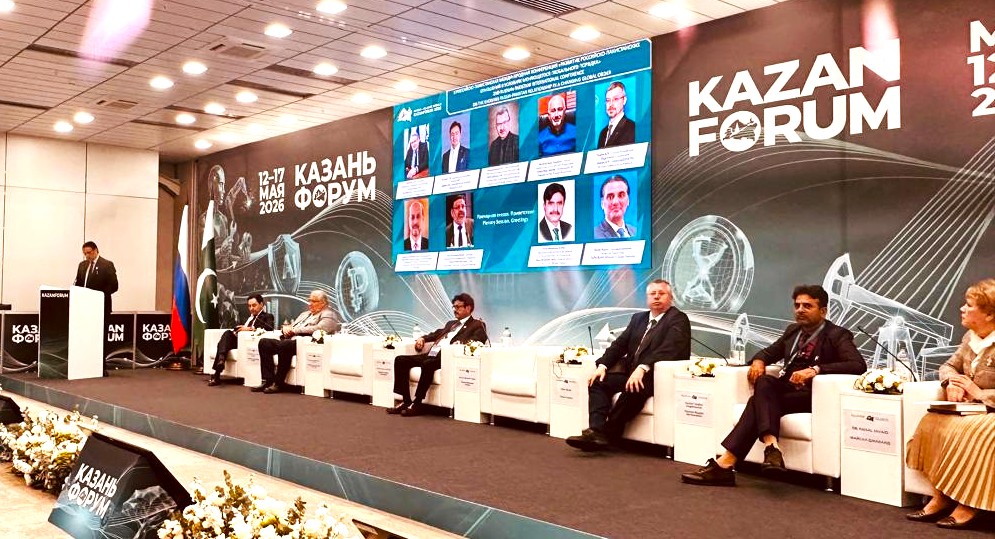
At the Kazan Forum, the PMSA Talha Burki outlined an ambitious vision for port diplomacy that stretched beyond routine trade signalling into strategic connectivity ambitions
MM Report
KAZAN, RUSSIA: Pakistan moved a step further in its bid to recast regional trade geography this week, signaling an ambition to fold its southern deep-sea gateway, Gwadar Port, into a wider Eurasian logistics architecture that already stretches from Russia to China and the Gulf.
At the Kazan Forum, the prime minister’s special assistant, Talha Burki, set out a vision that went beyond routine port diplomacy. He indicated that Islamabad wanted Gwadar to be integrated with Russia’s north–south trade artery, the International North–South Transport Corridor, in effect extending its reach towards the Arabian Sea and opening the possibility of a continuous supply chain linking Central Asia, Russia and onward maritime routes.
In the same breath, the plan gestured towards alignment with China’s Belt and Road Initiative, suggesting an attempt to place Pakistan at the overlap of two of the most ambitious infrastructure frameworks currently reshaping global trade flows. In practical terms, Islamabad has already begun adjusting the commercial pitch of Gwadar in anticipation of that role.
Port charges have reportedly been reduced significantly, by as much as 40%, in an effort to draw in cargo that might otherwise move through more established regional hubs. Operations have also been extended towards round-the-clock activity, a signal that authorities are seeking to move the port away from its underutilized reputation and towards a functioning trans-shipment node.
Alongside this, 100 acres of terminal space have been set aside for Central Asian freight, a move designed to attract landlocked economies that have long sought shorter and more predictable access to warm-water routes.
Gwadar has increasingly been presented not simply as an infrastructure asset but as a diplomatic instrument, positioned at the junction of competing corridors that have come to define Eurasia’s emerging trade order.
Yet the ambition remains, for now, largely declaratory. The physical and political infrastructure required to fuse these systems into a single functioning network is still uneven, and regional rivalries over ports, routes and influence remain deeply entrenched.
Even so, Islamabad’s messaging was unmistakable: geography was being treated not as a constraint, but as a resource to be leveraged, and connectivity as a form of strategic influence in its own right.
