





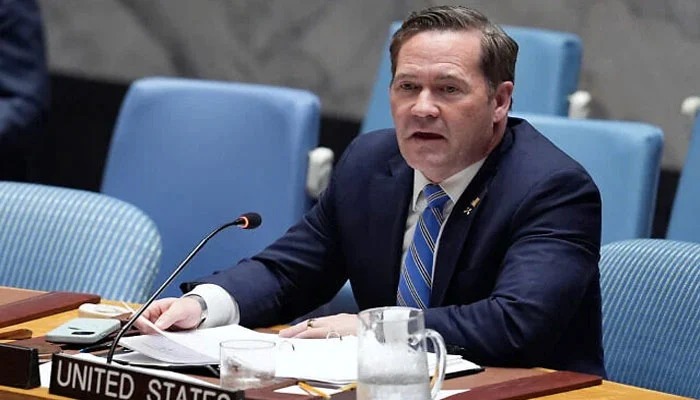
By Amjad Qaimkhani
UNITED NATION: The United States’ ambassador to the United Nations, Mike Waltz, said Washington had detected what it described as an early recalibration in China’s approach towards Iran, following President Donald Trump’s recent visit to Beijing, in remarks that added fresh momentum to already tense geopolitical signaling between the world’s two largest economies.
Waltz claimed that China had begun to scale back aspects of its alignment with Iran, including agreeing that Tehran should not pursue nuclear weapons. He further asserted that Beijing had indicated it would not introduce any form of “toll regime” in the Strait of Hormuz, a critical passage through which a significant share of global oil shipments is transported. The remarks were presented as part of a broader US reading of shifting diplomatic calculations in the Gulf and wider Indo-Pacific region.
In a separate televised interview, Trump said China had committed not to supply military equipment to Iran and expressed confidence that the Strait of Hormuz would remain open to global shipping without disruption. He also suggested that Chinese President Xi Jinping had signaled willingness to support efforts aimed at maintaining maritime stability and ensuring freedom of navigation in the region’s key waterways.
The statements were not independently verified, and Chinese authorities have not publicly confirmed any such commitments regarding Iran’s nuclear program, arms transfers, or maritime arrangements in the Gulf. Beijing has historically maintained that its relationships in the Middle East are based on non-interference and economic cooperation, while resisting alignment with US-led security narratives in the region.
The exchange of claims reflected the broader strategic contest between Washington and Beijing, where diplomatic messaging increasingly intersects with energy security, maritime trade routes and nuclear non-proliferation concerns. The Strait of Hormuz, in particular, has remained a persistent focal point in global security calculations, given its central role in international energy flows and its vulnerability to regional escalation.
While the US framing suggested a possible softening in China’s positioning towards Iran, analysts noted that such shifts, if confirmed, would likely unfold gradually and remain subject to competing strategic interests rather than immediate policy realignment.
