





By Ghulam Hussain Baloch
KALAT: The elections of the Mir Ahmed Yar Khan Press Club, Kalat, have been completed, with a new leadership formally taking charge following a well-attended and closely observed democratic process among the local journalist community.
According to the results, senior journalist Shadi Khan Mengal has been elected president, while Mir Ghulam Hussain Shahwani has been elected general secretary. The elections were marked by active participation from journalists, who exercised their vote to select a new cabinet, reflecting what participants described as a continuation of democratic traditions within the press fraternity.
Other elected office-bearers include Faiz Nechari and Qadir Shah as vice presidents, Abdullah Lehri as second vice president, Muhammad Yousaf Mengal as deputy general secretary, Bebarg Lehri as press secretary, Amjad Salami as information secretary, Zia-ur-Rehman as finance secretary, Israrullah as joint secretary, Abdul Waheed Dhor as office secretary, Maqbool Shahwani as auditor, and Shoaib Ahmed as coordinator.
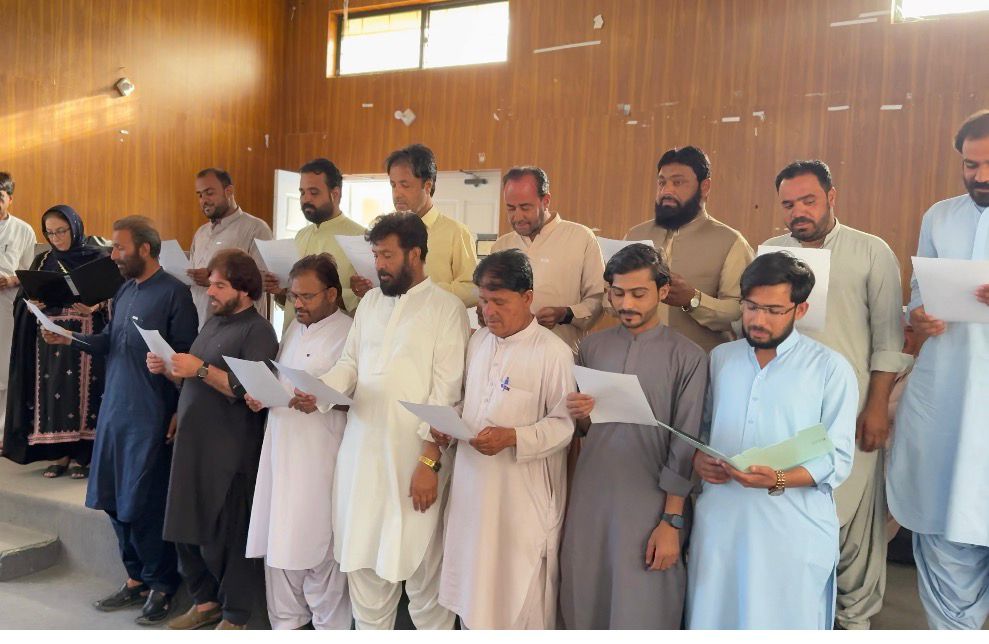
Following the announcement of results, a formal oath-taking ceremony was held in Kalat, attended by a large number of political, social, literary, journalistic and business figures from the district. The chief guest on the occasion was former Member of the National Assembly and former provincial law minister Rubina Irfan, a senior leader of the Pakistan Peoples Party, who administered the oath to the newly elected cabinet.
The event was also attended by representatives of the bureaucracy, traders’ associations, Hindu Panchayat, lawyers, teachers, writers, social activists and members of civil society, who expressed solidarity with the journalist community. Participants extended congratulations to the newly elected office-bearers and expressed hope that the new leadership would work towards strengthening journalism in Kalat, addressing journalists’ issues, and improving the functioning of the institution.
Speakers at the ceremony highlighted the importance of journalism in society, describing it as a cornerstone of public awareness and accountability. They said journalists serve as the “eyes and ears” of society by bringing public grievances, governance issues and community concerns into the public sphere and connecting them with decision-making institutions.
They acknowledged the challenges faced by journalists in the current environment but praised their continued commitment to professional responsibilities. The Mir Ahmed Yar Khan Press Club, they noted, has historically played an important role in promoting journalistic values, freedom of expression and highlighting local issues, serving as a platform not only for journalists but also for broader civic engagement in the region.
Rubina Irfan, addressing the gathering, congratulated the new cabinet and described journalism as the fourth pillar of the state, emphasising its central role in democratic stability and social development. She praised the work of local journalists in Kalat, saying they continue to highlight public issues despite limited resources, and assured continued support for their welfare and professional development.
The newly elected president, Shadi Khan Mengal, and general secretary, Mir Ghulam Hussain Shahwani, thanked the journalist community for their trust and pledged to uphold it. They said their priorities would include safeguarding journalists’ rights, improving welfare measures, promoting training opportunities for young journalists, and modernising the press club in line with contemporary requirements.
They further committed to strengthening institutional capacity, expanding professional training programmes, and ensuring collective decision-making in the functioning of the press club. The leadership also expressed gratitude to political, social and official circles for their participation and support during both the elections and the oath-taking ceremony.
The event concluded with goodwill messages for the new cabinet, with participants expressing hope that the new leadership would strengthen journalistic traditions, amplify public issues, and play an effective role in the development of Kalat and protection of journalists’ rights.
