





By Pervaiz Mughal
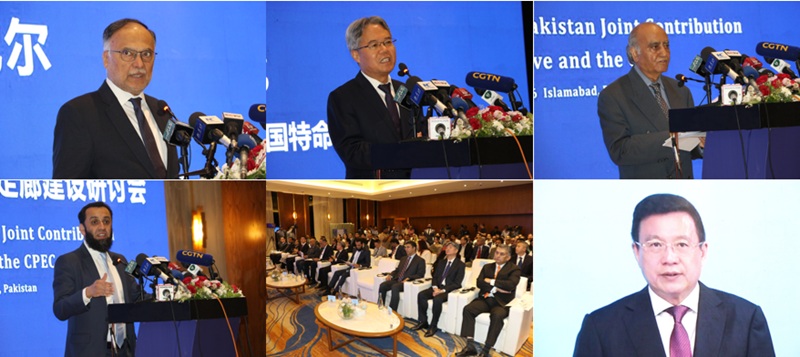
ISLAMABAD: The Institute of Strategic Studies Islamabad (ISSI), in collaboration with Xinhua News Agency, hosted a commemorative seminar titled “75 Years of Friendship: China-Pakistan Joint Contributions to the Global Governance Initiative and CPEC” at the Marriott Hotel Islamabad.
The seminar brought together federal ministers, senior diplomats, scholars, media representatives and practitioners from Pakistan and China to mark the 75th anniversary of diplomatic relations and reflect on the evolving trajectory of the all-weather strategic cooperative partnership.
Fu Hua, President of Xinhua News Agency, extended felicitations to Pakistan and China on the 75th anniversary of diplomatic relations and reaffirmed the enduring strength of the all-weather strategic cooperative partnership. He noted that both countries had consistently supported each other through changing international circumstances, setting a model of state-to-state relations based on mutual trust, solidarity and shared interests.
In his welcome remarks, Ambassador Khalid Mahmood, Chairman BoG ISSI, described Pakistan-China relations as an all-weather strategic cooperative partnership anchored in mutual trust, sovereign equality and consistent support for each other’s core interests. He said the partnership had become an important pillar of regional peace and stability.
Chief guest Federal Minister for Planning, Development and Special Initiatives Ahsan Iqbal, in his keynote address, described Pakistan-China relations as a unique and exemplary strategic partnership built on trust and mutual support.
Federal Minister for Information and Broadcasting Attaullah Tarar, in his keynote address, described Pakistan-China relations as an “iron-clad” friendship rooted in mutual trust, shared aspirations and unwavering support across generations. He said the relationship had evolved into a model partnership that continued to deepen in scope and significance.
Highlighting CPEC as a flagship project of Belt and Road cooperation, he noted its contributions to Pakistan’s energy security, infrastructure development and connectivity. He further stated that CPEC Phase-II would focus on industrial cooperation, agriculture modernisation, special economic zones, green development, innovation and people-centric socio-economic uplift.
He outlined CPEC Phase-II priorities under five strategic corridors—growth, livelihood, innovation, green development, and opening-up and regional connectivity—emphasising high-quality and inclusive development.
He highlighted CPEC as a transformative initiative contributing to connectivity, development and prosperity, while stressing the importance of cultural exchanges, media cooperation and people-to-people contacts in strengthening bilateral ties.
Chinese Ambassador to Pakistan Jiang Zaidong, in his keynote address, termed the 75th anniversary a major milestone in bilateral relations, underscoring sustained high-level exchanges and deepening strategic trust. He reiterated that CPEC remained the central pillar of Belt and Road cooperation, with significant achievements in energy, infrastructure, investment and employment generation. He also highlighted its evolution towards high-quality development through expanded cooperation in agriculture, industry, mining, science and technology and livelihood-oriented initiatives, while reaffirming commitment to global governance principles of multilateralism, sovereign equality and international law.
The seminar also featured the presentation of the book “China’s Governance under Xi Jinping’s Leadership (English Edition)”, showcasing China’s governance experience and development trajectory.
The first thematic session, chaired by Ambassador Naghmana Hashmi, former Ambassador of Pakistan to China, focused on Pakistan-China cooperation in advancing the Global Governance Initiative and CPEC Phase-II. Speakers highlighted the growing importance of inclusive global governance in a rapidly evolving international environment and emphasised CPEC’s role in translating these principles into practical outcomes through connectivity, industrial cooperation, innovation, green development and livelihood enhancement. The discussion underlined the need to ensure that the benefits of economic cooperation reach ordinary citizens through skills development, education and SME growth, while also strengthening media narratives and policy coordination.
The second session, chaired by Mr Tang Binhui, Head of Xinhua News Agency’s Islamabad Bureau, focused on “Pakistan-China Young Talents’ CPEC Story Sharing.” It highlighted the human and people-to-people dimension of CPEC, with speakers sharing personal experiences of collaboration, including long-term field engagement in infrastructure and energy projects, academic exchanges and professional development through bilateral cooperation. They emphasised that CPEC was not only a framework for economic connectivity but also a bridge between societies, fostering trust, cultural understanding and enduring ties between the peoples of both countries.
Fu Hua, President of Xinhua News Agency, emphasised that the Global Governance Initiative (GGI), as envisioned by President Xi Jinping, promoted a more equitable and inclusive international order, and highlighted CPEC as a practical embodiment of these principles through infrastructure development, connectivity, energy cooperation and regional prosperity. He also underlined the role of media and think tanks in enhancing mutual understanding and strengthening people-to-people ties.
The seminar concluded with a reaffirmation of the enduring Pakistan-China friendship and a shared commitment to advancing high-quality development, deepening regional connectivity and promoting a more inclusive and equitable international order. Participants expressed confidence that the continued evolution of CPEC and cooperation under global governance initiatives would further strengthen the all-weather strategic cooperative partnership and contribute to regional peace, stability and shared prosperity.
