





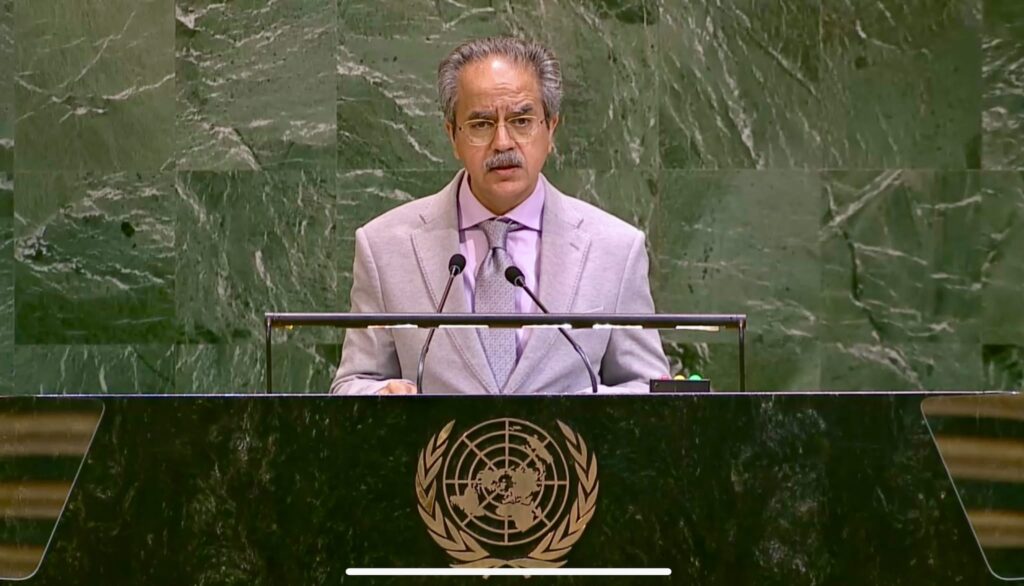
By Amjad Qaimkhani
NEW YORK: Pakistan called on the international community to uphold the principle of the Responsibility to Protect (R2P) without discrimination or political selectivity, arguing that the doctrine had failed its most important test in situations of prolonged conflict and foreign occupation where civilians continued to face grave atrocities without accountability.
Addressing the United Nations General Assembly debate on the Responsibility to Protect and the Prevention of Genocide, War Crimes, Ethnic Cleansing and Crimes against Humanity in New York on Monday, Asim Iftikhar Ahmad said the international community had fallen short of fulfilling the promise of “Never Again”, leaving victims of mass atrocities without protection, justice or accountability.
The Pakistani envoy described genocide, war crimes, ethnic cleansing and crimes against humanity as among the gravest violations of international law. He recalled that the Responsibility to Protect framework was endorsed by world leaders during the 2005 World Summit to ensure that populations facing such crimes would receive protection when national authorities were unable or unwilling to act.
However, he said that more than two decades later, the international community continued to witness an unprecedented number of armed conflicts, while the framework itself remained weakened by inconsistent implementation and political divisions.
According to Ambassador Asim, the shared commitment to prevent mass atrocities had too often been undermined by inaction, denial, selective application of international principles and institutional paralysis within the global system.
Referring to the outcome document adopted at the 2005 World Summit, he said the Responsibility to Protect was founded on a balance between the obligations of individual states to safeguard their own populations and the collective responsibility of the international community to respond when those obligations were not met.
